As global travel rebounds, Africa is emerging as one of the fastest-growing regions for short-term rentals. In 2022 alone, Airbnb’s impact in South Africa exceeded R23.5 billion and supported nearly 50,000 jobs, illustrating the continent’s massive upside. Meanwhile UN data show international arrivals in Africa up 7% above pre-pandemic levels (outperforming most regions)]. This surge in tourism, combined with a growing middle class, more digital nomads, and underdeveloped hotel infrastructure, makes now an ideal time to invest in African Airbnb properties. Think of this as your Airbnb beginner’s guide: we’ll walk through why Africa is ripe for hosting, how to get started step by step, tips on choosing properties, optimizing listings (your “Airbnb listing optimizer” strategy), pricing for profit, navigating local rules, and avoiding newbie mistakes. By the end, you’ll have expert, actionable advice (with real data and charts) to turn your first Airbnb into a thriving income stream.
Why Africa is the Next Big Airbnb Opportunity
Tourism is exploding. Recent reports show Africa leading the global travel recovery. According to the UN World Tourism Barometer, Africa saw a 7% increase in international arrivals compared to 2019 , higher growth than virtually any other region. North African destinations (like Morocco, Egypt) grew a remarkable 22% over pre-pandemic levels. With international tourism now nearly back to 2019 levels globally, Africa’s share is rising fastest. For example, Kenyans welcomed 21.2% more visitors in 2023 after a major tourism marketing push. Major events (like the Africa Cup or conferences) and marketing campaigns are drawing business and leisure travelers alike.
Underdeveloped supply; high demand. Unlike in Europe or North America, many African cities have far fewer professional short-term rentals per capita, meaning less competition. In Nairobi or Accra or Tunis, you often compete only with local hotels or a handful of Airbnb-style guesthouses. That pent-up demand translates to high occupancy and rates. In Nairobi, for example, a single Airbnb host can earn roughly Ksh 900,000 (~$7K) per year even at <50% occupancy, often more monthly cash flow than a long-term lease. Zanzibar and Johannesburg are seeing a similar boom as beach and safari travel pick up. Even non-tourist cities in Kenya, Nigeria, or Tanzania are drawing more domestic travelers via Airbnb than ever. A new Airbnb report notes rising visits to lesser-known spots as locals and visitors alike explore away from crowds.
Easier entry for hosts. Many African regulators currently welcome Airbnb as a development tool. For instance, South Africa reports “no specific short-term rental regulations” beyond existing housing laws, and Kenya’s tourism board actively lists home stays as licensable accommodations. Airbnbs often “eat into” hotel demand, yet the platform allows ordinary homeowners to join with minimal fees. In Kenya it’s noted that listing a unit requires little upfront capital, you can start by renting and furnishing an apartment or converting a spare guesthouse. Even better, tech-savvy African hosts can screen guests and automate key exchanges, making hosting more secure and scalable.
Strong growth momentum. International tech and travel companies are now investing in Africa’s hospitality. Airbnb itself pledged $500K to boost African tourism and has launched local “Airbnb Academies” to train hosts. Independent analyses show Airbnb’s African host earnings doubling in some markets. All this momentum means early hosts can ride the wave: establish a strong listing now in a city (e.g. Nairobi, Cape Town, Marrakech, Zanzibar) while others are just catching on. In short, thanks to rising tourism, underutilized housing, and supportive attitudes, Africa is where the next hospitality boom is happening.
How to Start Airbnb Hosting in Africa: A Step-by-Step Beginner’s Path
Research and Planning:
Treat your new venture like a business. First, pick a city or region with strong demand and affordable property prices. Utilize data sources (e.g. Airbtics, AirDNA, RehAnalytics) to see typical occupancy and rates. For example, median occupancy in Nairobi is ~47% with an average rate of ~$44/night. In Zanzibar it’s about 40% occupancy at $49/night. Compare that to your estimated costs (rent/mortgage, utilities, cleaning, management fees) to ensure a healthy margin. A simple rule: aim for 10%+ yield on your property’s value. In practice, many hosts target 15–20% annual ROI, but remember local factors (seasonality, taxes, inflation) can swing returns.
Legal Setup:
Ensure compliance with local laws before hosting. Register your business or obtain any required permits. For instance, in Kenya all furnished rentals must register with the Tourism Authority (one-time fee ~Ksh1,000 + annual Ksh26,000 per unit). Some cities require a business license (e.g. Kenya’s single permit ~Ksh10,000). In South Africa, keep detailed income records for tax and note the R50,000 VAT threshold. Find out if local municipalities (like Cape Town) have by-laws for short lets (Cape Town allows up to 30-day stays under a 2019 by-law). Tip: Join local Airbnb host groups or consult a lawyer/agent so you don’t get caught off guard by sudden rule changes.
Financing and Budgeting:
Calculate all startup costs. This includes furnishing and outfitting the space (furniture, appliances, decor), plus recurring costs (cleaning, utilities, internet, host insurance). In South Africa, furnishing a one-bedroom Airbnb averages ZAR26K (about $1.4K). In Kenya or Tanzania, costs may be lower or higher depending on imported goods, expect at least $1–3K to properly furnish a modest unit. Also budget an emergency fund for repairs or slow months. If you need financing, start with just one property or even a spare room (often called “co-hosting”) to test the waters before scaling up.
Property Setup:
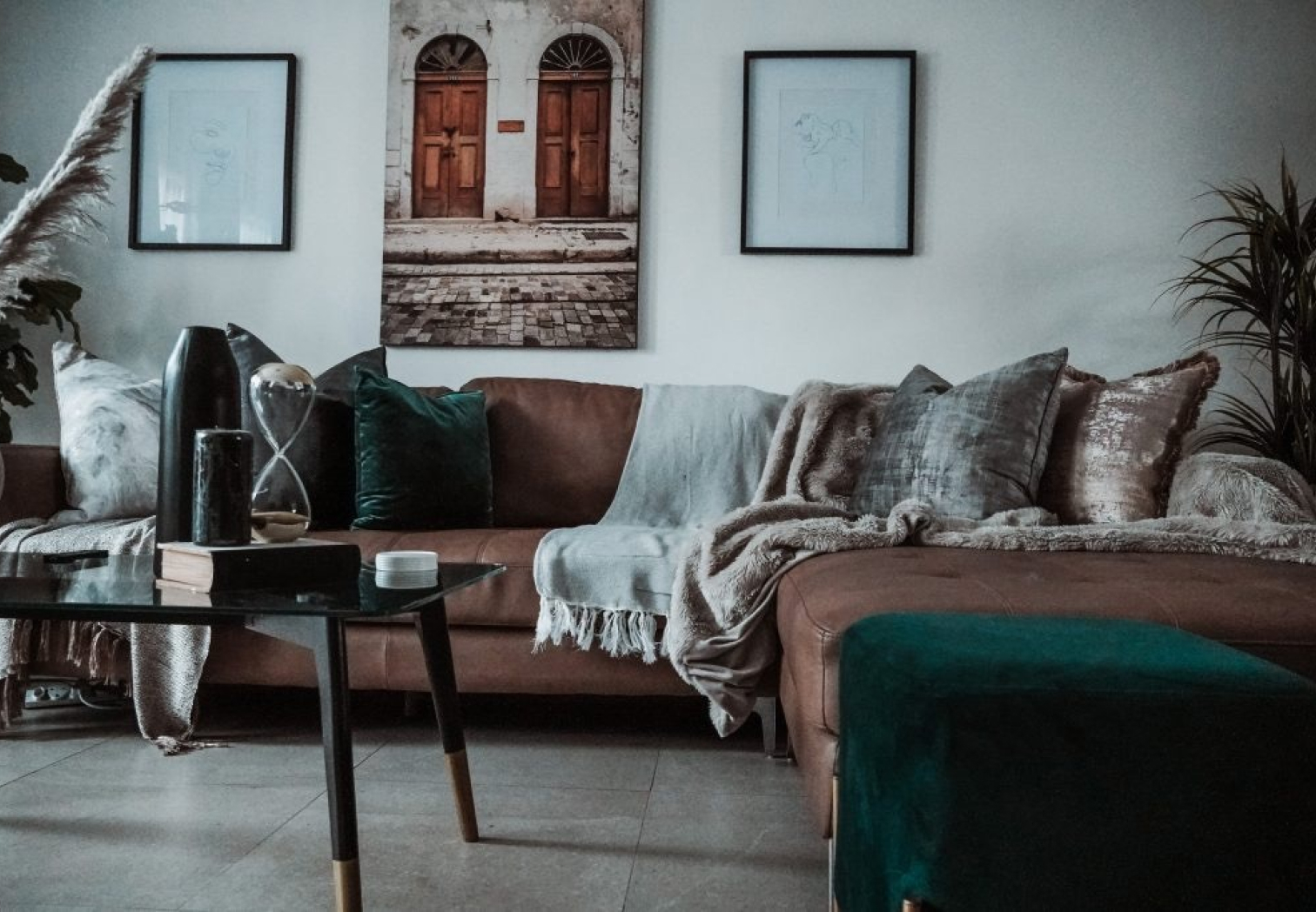
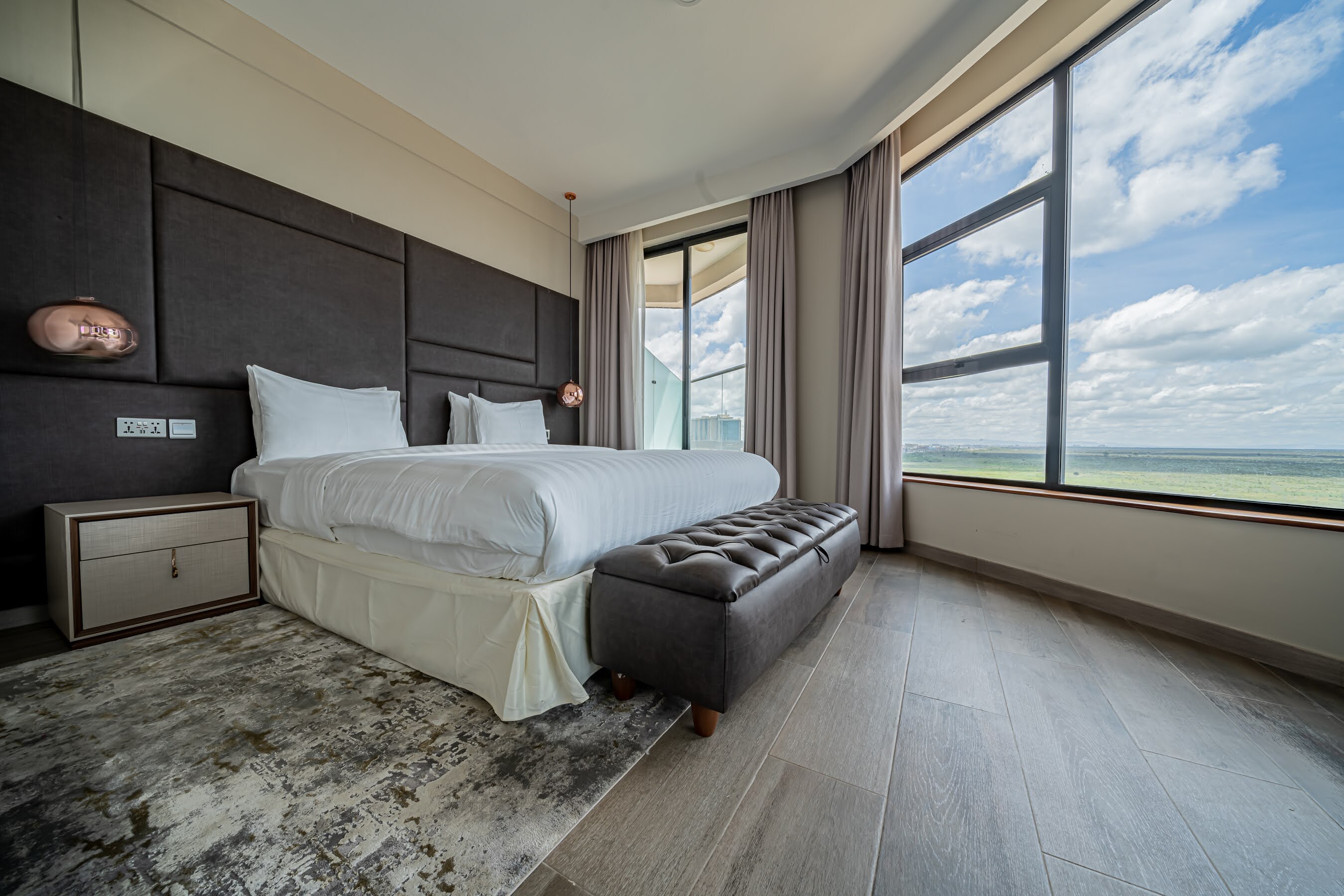
Choose a property that appeals to travelers. Furnish it comfortably and neutrally: think sturdy beds, fast Wi-Fi, air conditioning or fans, and good lighting. Equip full basics (kitchen utensils, linens, toiletries). In Africa, international guests still value home comforts, a simple welcome basket of local treats or a coffee maker can boost your reviews. Keep decor tasteful (avoid overly flashy or culturally confusing themes). Ensure basic safety: secure locks, smoke detectors, and clean the space thoroughly. Take high-quality photos once setup is complete (see next section).
Create Your Listing:
Sign up on Airbnb (and consider other platforms like Vrbo or rehanisoko.com or Booking.com). Write a compelling title and description using clear keywords (“downtown Nairobi apartment,” “Cape Town beachfront villa,” etc.). Mention standout amenities (pool, Wi-Fi, AC) and unique touches (e.g. “rooftop view,” “safari gear available”). Set initial pricing competitively by surveying similar listings in your area. Many hosts use dynamic-pricing tools (Pricelabs, BeyondPricing, RehAnalytics) to adjust rates by season. Publish your listing and double-check availability to avoid overlaps. It’s usually helpful to start with a few days blocked off (flexibility) to accumulate some early reviews.
Go Live & Manage:
Once live, respond to inquiries quickly. Implement an organized system for guest communication: use templates for check-in instructions, house rules, and FAQs to save time. Consider automation tools (e.g. scheduling messages or locks) once you have multiple listings. Keep your calendar up-to-date to avoid cancellations, cancellations and “no-shows” severely hurt your search rank. Finally, always inspect and clean thoroughly between guests; a clean, well-stocked space is the bedrock of 5-star reviews and repeat bookings.
Quick Start Checklist:
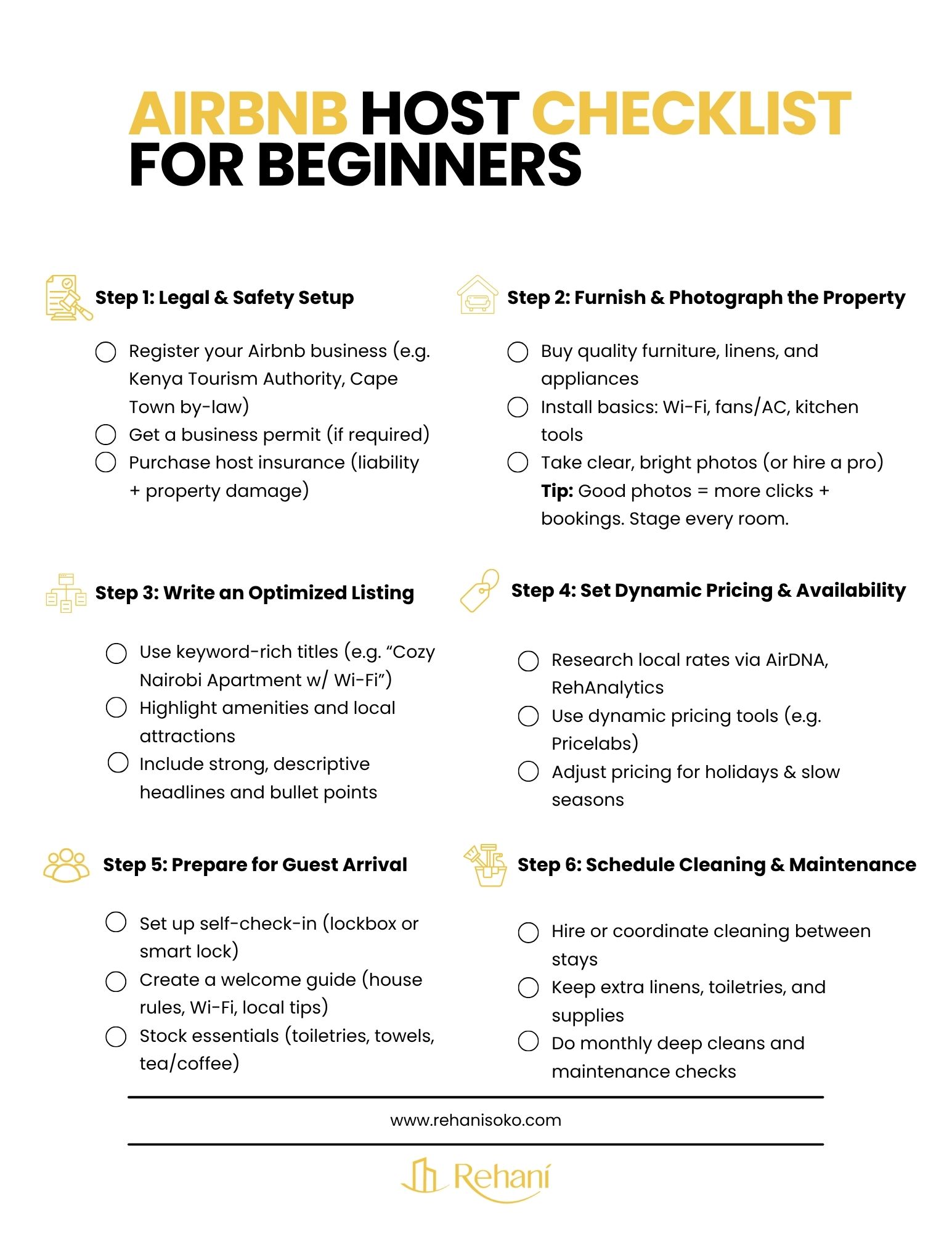
From signing up on Airbnb to welcoming your first guest, keep a running checklist. Ensure you’ve: researched market rates, secured financing, completed any legal registrations, furnished the space, taken stellar photos, written a keyword-optimized listing, set competitive pricing, and prepared welcome information for guests. (An infographic checklist in the Tools section below offers a helpful summary of all these steps.)
Smart Property Selection: What to Look for as a New Investor
Location is King
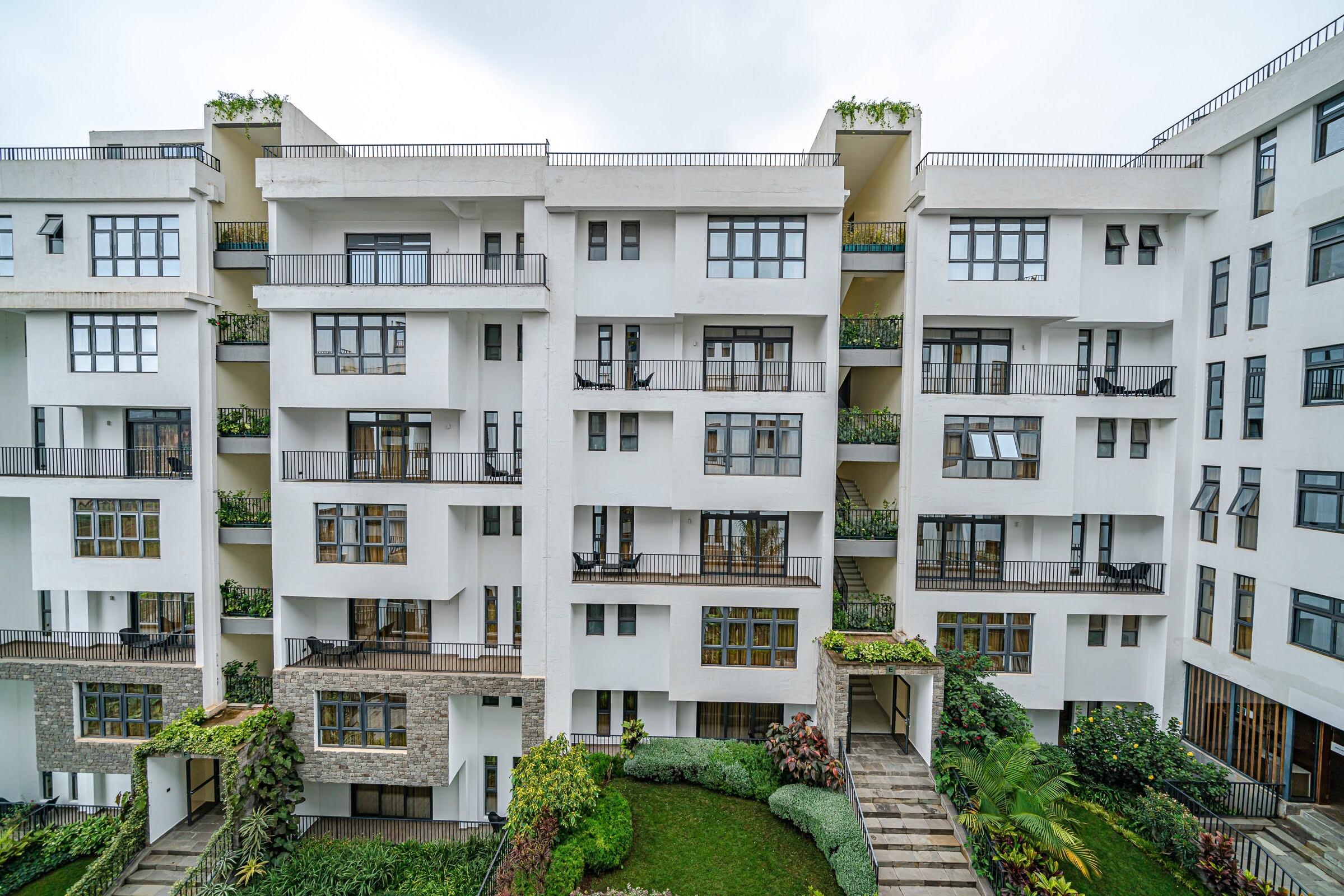
Choose neighborhoods that guests actually want. In cities like Nairobi, Cape Town, or Accra, look for areas near business districts or tourist attractions, safety, transit access, and amenities matter. Properties near national parks, beaches, or cultural sites (e.g. Zanzibar Stone Town or Cape Town’s CBD) command higher rates. Conversely, avoid areas with severe crime or unreliability in services. In Africa, even urban “sleepy” suburbs often attract business travelers who seek quiet, so don’t overlook up-and-coming residential zones.
Property Type & Size
Decide if you’ll rent a single room, a whole apartment, or a house. In Africa’s metropolises, one-bedroom apartments often hit a sweet spot for couples or solo travelers. (The cost of adding bedrooms and bathrooms rises quickly.) Larger family homes or villas can fetch high nightly rates, especially on holiday islands, but require much more capital and management. For new hosts, a simple one-bed flat or a studio is easier to manage and maintain. Ensure the layout is visitor-friendly: guests should have privacy, a dedicated sleeping area, and at least one good bathroom.
Capacity & Flexibility
Maximum guests and minimum-night rules affect revenue. More beds mean higher income per booking, but only if there’s demand (e.g. a family safari group or business conference can fill a 4-bed house). Many beginners make the mistake of allowing too many guests or too-short stays without sufficient cleaning plans. As a rule, start modestly (say up to 4 guests, 2-night minimum) until you know how quickly spaces turnover. And always comply with building rules: many apartments or homeowner associations in Africa have occupancy limits or “short-let” policies; be sure to check.
Affordability and ROI
Finally, do the math on purchase/rental cost vs. expected income. In markets like Cape Town, properties are pricier, but high occupancy (70%+) and ADR (~ZAR1,439) mean annual Airbnb revenue around ZAR359,000 (approximately $19K USD). In Nairobi, a more affordable apartment may earn ~$7K/year. Compute your potential annual yield: a common benchmark is 10%+ of property value. For example, a $100,000 home should aim to net $10,000 per year after expenses. If your calculations fall short, consider a different location or property type before investing.
Airbnb Listing Optimization Techniques for Maximum Visibility
Optimizing your listing is like doing SEO for search engines, it gets you more views and bookings. Follow these key strategies:
- Keyword-Rich Title & Description: Craft a clear, descriptive title that travellers might search. E.g. “Cozy Beachside Studio in Cape Town” or “Modern Nairobi Apartment w/Wi-Fi”. In the description, mention key amenities and attractions (“free Wi-Fi, 10-min to CBD, near national park”), and use related search terms (vacation rental, self-catering, Airbnb beginner’s guide tips etc.) that guests might use.
- High-Quality Photos: Pictures are the #1 decision factor. Invest in professional photos or at least use a good camera in daylight. Show every space: bedroom, bath, kitchen, living area, exterior view. Make sure each photo is sharp, bright, and accurately staged (tidy, decluttered). According to Airbnb experts, compelling images dramatically increase shares and wishlists, which in turn raise your listing’s popularity in search. A common pitfall is too few or low-quality shots; remedy that immediately.
- Accurate Amenities & Tags: Airbnb’s search filters rely on your selected amenities. Don’t skip ticking off Wi-Fi, hot water, self check-in, etc. If you can, add extras like “Airbnb Listing Optimizer Essentials” , for example, a hand-drawn map to local markets, or a guidebook for digital nomads, to stand out. Make sure to update any changes to avoid guest complaints (e.g. if Wi-Fi is down, uncheck that amenity until fixed).
- Maintain a Healthy Listing: Keep your calendar up-to-date and avoid cancellations. Airbnb penalizes listings for gaps and last-minute call-offs and so does Rehani Soko. Frequent cancellations also anger guests. If your place is booked on certain dates, block them properly; if a guest cancels, fill the slot quickly. An active, well-maintained calendar signals an engaged host and boosts search ranking.
- Respond & Review: A quick response rate and earning early positive reviews are essential. Answer inquiries within an hour if possible, Airbnb algorithms favor responsive hosts. After each stay, encourage polite reviews (leave a thank-you note or small gift); high ratings and recent reviews push your listing higher. If guests often ask the same questions (about check-in or parking), update your listing’s FAQ or description to remove booking obstacles. Removing such “objections” (like unclear instructions) helps guests book faster, which also improves your listing’s performance.
These listing optimization steps work together as an Airbnb Listing Optimizer strategy: think of continually tweaking your title, photos, pricing, and communication just as you would iterate on a business plan. The goal is to boost your listing’s visibility and conversion rate, filling the calendar with minimal vacancy.
Pricing & Revenue: How Much Can You Really Make?
Calculating potential earnings is crucial. African Airbnb returns vary widely by city, property, and management quality. Here are some data points to frame expectations:
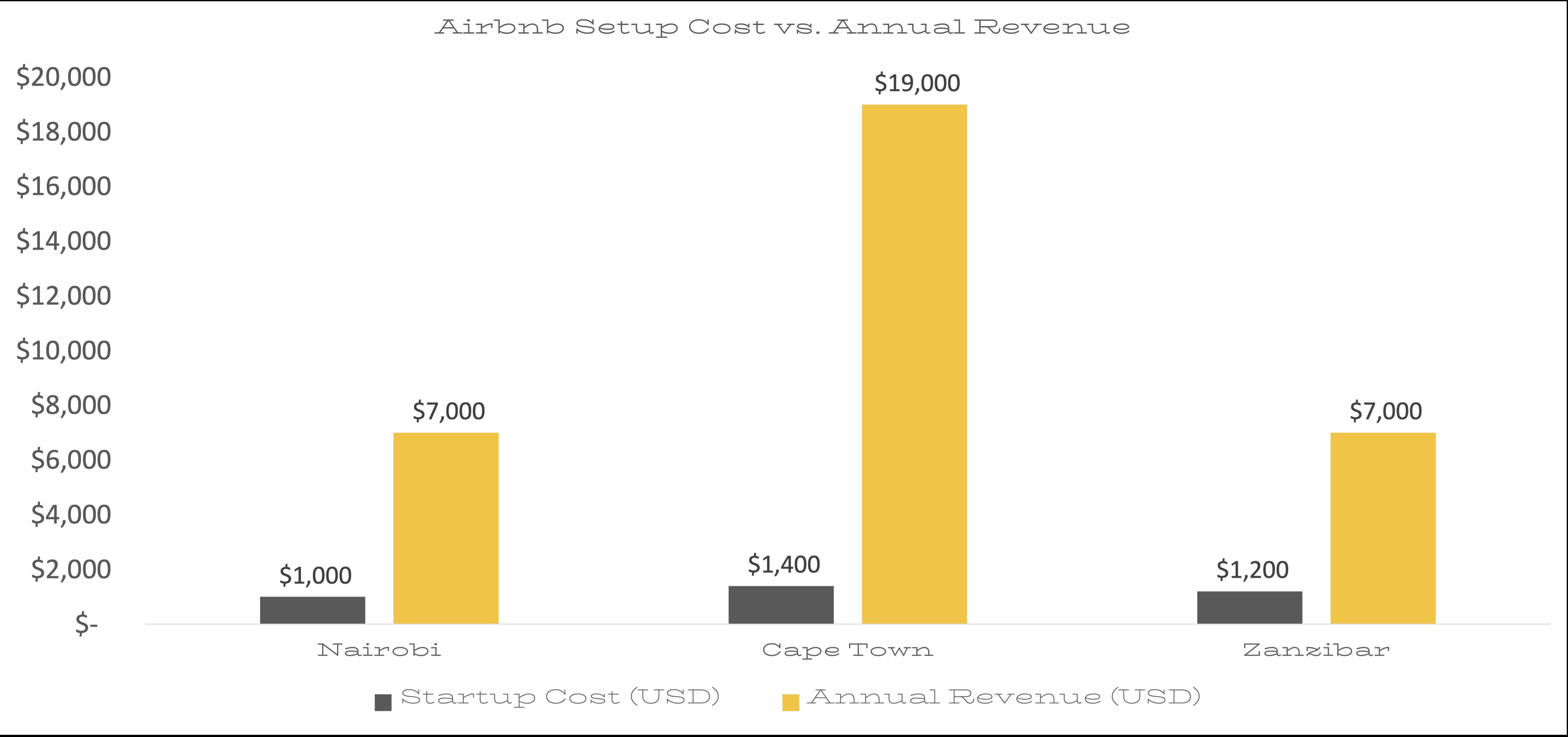
- Average Income Examples: In emerging markets like Kenya and Tanzania, the typical host earns around $7,000 per year. For example, Airbtics reports a typical Nairobi or Zanzibar listing pulling in roughly $7K annually. This aligns with local reports: a Nairobi Airbnb with 50% occupancy can net about Ksh 900,000 (~$7K) per year. In contrast, top-tier markets like Cape Town generate far more. One analysis shows an average South African host in Cape Town earned about ZAR 359,128 ($19K) per year, with 71% occupancy at R1,439/night.
- Typical Occupancy & ADR: Expect seasonal swings. Many African destinations have clear high/low seasons (e.g. Cape Town is busiest Dec-Feb, Zanzibar surges in June-Aug). Use annual averages (like the 47% occupancy in Nairobi) to gauge. Higher occupancy and higher nightly rates directly lift income. Use dynamic pricing tools like RehAnalytics or manual adjustments to charge more in peak months. Remember to factor in vacancies: leaving a calendar gap even for a week costs as much as a 20% drop in rate.
- Startup vs. Payback: Let’s compare initial investment to earnings. A decent furnishing budget might be on the order of $1–3K for a one-bedroom in Africa (bed, sofa, kitchen gear, decor). Even this modest cost can be recouped within a few months if your listing is well-managed. For example, a Cape Town apartment earning $1,600/month (ZAR22,545) would recoup a $1.5K setup cost in under one month of bookings. In Nairobi or Zanzibar, a $600 monthly cash flow (which yields ~$7K/yr) would break even on a $1K investment in a couple of months. Of course, ongoing costs (cleaning, utilities, Airbnb fees) will reduce net profit, so include those in your calculations.
- Expected ROI: Industry benchmarks suggest that a 10% yearly yield on property value is considered a “good” return for short-term rentals. Ambitious hosts may aim for 15–20% or more by maximizing occupancy and upselling (additional guest fees, paid amenities). But actual ROI depends on many factors: occupancy, local taxes, financing costs, etc. Always do a conservative scenario (lower occupancy, higher costs) as your baseline. As one expert newsletter notes, occupancy, seasonality, and neighborhood “all affect how much you take home”, so plan accordingly.
- Up-Selling and Fees: You can increase revenue with smart extras. Charge for cleaning fees, extra guests (within your maximum), and optional add-ons (airport pickup, tours, local SIM cards). Many hosts implement a cleaning fee that roughly covers laundry and turnover costs. Be transparent about these fees to avoid guest surprises. You can also adjust minimum night stays (e.g. 3+ nights in peak seasons) to lengthen bookings and raise overall income.
- Tools & Calculators: Use revenue calculators (like RehAnalytics, Airbtics or AirDNA’s Rentalizer) to run projections on specific properties. These tools estimate nightly rates and occupancy based on local data. They can help you set realistic targets and track actual performance against projections once you start hosting.
In short, how much you make is very location-specific, but these figures offer ballpark guidance. Always budget for about 30–50% of revenue to go toward expenses (cleaning, maintenance, utilities), and you can expect net profit in the range of 10–20% of the property’s value if all goes well. With savvy pricing and a bit of luck in high season, Airbnb hosting across various African countries can be a highly lucrative part of your investment portfolio.
Legal, Licensing, and Local Considerations
Every country and city has its own rules. As an Airbnb host, you must navigate tax, zoning, and licensing to avoid fines or listing shutdowns. Key points:
Registration & Permits:
In Kenya, furnished rentals are regulated by the Tourism Authority. You must pay a one-time registration fee (about Ksh 1,000) and an annual license fee (around Ksh 26,000 per unit). Additionally, most Kenyan towns require a business permit (Single Business Permit) for operating a rental. In Tanzania and Zanzibar, enforcement is still lax, but it’s wise to register with local authorities to avoid problems. In South Africa, there is no national Airbnb license, but municipalities (like Cape Town) may require hosts to comply with local by-laws (Cape Town allows up to 30-day stays as per a 2019 by-law). Always check municipal regulations: for example, Kigali or Marrakech might have their own rules for STRs.
Taxes:
Airbnb income is generally taxable. In South Africa, any income above ZAR50,000/year triggers VAT registration, and all hosts must report earnings to SARS. In Kenya, rental income is taxed under different brackets, and international hosts may need to pay a digital services tax on platform earnings. Consult a local accountant. Keep meticulous records of all earnings and deductible expenses (furniture, repairs, utility bills), you can often offset many costs against income. A good starting point: Airbnb offers tax guides for each country (e.g. a South African tax guide partnership.
Insurance and Liability:
Host insurance is crucial. While Airbnb provides some Host Guarantee, its coverage is often limited. Consider a local short-term rental insurance policy that covers property damage, liability (guest injuries), and loss of income. Also check your homeowner’s or landlord’s insurance, many standard policies don’t cover business use. Given issues like fire safety and theft in some markets, insurance adds peace of mind.
Zoning and HOA Rules:
If you buy in a condo or gated community, ensure that the Homeowners’ Association allows short-term rentals. Some developments (especially luxury ones) may ban Airbnbs. Similarly, confirm whether the property is zoned for rentals. Purchasing property with Airbnb in mind has become popular enough that some projects are now marketed as “Airbnb-friendly” developments.
Cultural & Practical Considerations:
In some African countries, neighbors may be sensitive to foreigners or parties. Clearly state “no noise after 10 PM” in your house rules to prevent conflicts. Also be mindful of local customs (e.g. modesty rules, alcohol restrictions). Provide ample instructions on any special procedures (like handling exotic appliances or navigating curfews). Good cultural training can prevent misunderstandings and negative reviews.
By handling these legal and local details upfront, you build trust with authorities and guests. Never skip compliance; it not only avoids fines but also boosts your reputation. (A legal, well-registered host is always more credible than one flying under the radar.)
Common Mistakes Beginners Make and How to Avoid Them
Even enthusiastic hosts stumble on repeat pitfalls. Learn from these common errors:
Poor Listing Quality:
Mistake: A bland title/description or bad photos will tank visibility.
Solution: Invest time in listing optimization (see above). Use relevant keywords in your title/description and update it regularly. Verify every amenity is ticked. Overlooked detail can confuse guests and kill bookings.
Slow or No Communication:
Mistake: Waiting hours (or days) to reply causes lost bookings and bad reviews.
Solution: Respond within an hour. Use auto-responders or a smartphone app to manage messages. Keep FAQs on hand. Proactive communication (e.g. “welcome, how was your travel?”) builds guest confidence and often yields repeat stays.
Low-Quality Photos:
Mistake: DIY snapshots in poor light make your place look average or worse.
Solution: Hire a photographer or learn basic staging/lighting. Even a smartphone can work if used during golden hour. Remember: better photos increase time spent on your listing, which boosts search ranking.
Ignoring Amenities:
Mistake: Not providing basics (Wi-Fi, hot water, clean linens) leads to unhappy guests.
Solution: Ensure your listing’s promises match reality. In Africa especially, fast Internet and reliable power often top guest checklists. Invest in a backup battery or generator if outages are common.
Static Pricing:
Mistake: Charging a flat rate year-round (or setting a high minimum stay) means missing out on peak-season premiums.
Solution: Use dynamic pricing. Adjust nightly rates upward during holidays and events, and consider shorter minimum stays in shoulder seasons to increase occupancy. Just like hotels, the flexible-rate model maximizes revenue.
Overdependence on Airbnb:
Mistake: Relying solely on Airbnb’s traffic can be limiting.
Solution: List on multiple platforms (Rehani Soko, Vrbo, Booking.com) and consider creating a simple direct-booking webpage or using a channel manager to diversify. This not only widens your audience but also gives you leverage (Airbnb fees are typically higher for exclusive bookings).
No Guest Screening or Rules:
Mistake: Allowing any booking without vetting can lead to party damage or law-breaking guests.
Solution: Use Airbnb’s guest requirements (verified ID, no young party groups). Clearly state house rules (e.g. no smoking indoors). A few screenings or rule reminders (via Airbnb’s messaging) can prevent costly incidents.
Lack of Insurance or Contracts:
Mistake: Operating without damage protection.
Solution: Get a proper insurance policy and require guests to agree to your damage policy. Always collect a security deposit through Airbnb or via local methods. This way, you’re not left paying out of pocket when wear-and-tear or guest mishaps occur.
Each of these mistakes can erode revenue or create headaches. Instead, focus on detail and professionalism: treat guests respectfully, meet their expectations, and continually refine your processes. An easy way to stay on track is our Airbnb Host Checklist infographic (below), which summarizes all essential tasks that new hosts should complete before and during hosting or visit our RehAnalytics tool page.
Tools & Resources to Simplify Your Airbnb Journey
Running an Airbnb can be complex, but many tools and resources can help you automate, analyze, and excel. Here are some key categories and examples:
- Market Data & Revenue Calculators: Use services like RehAnalytics, AirDNA or Airbtics to analyze local markets. These platforms provide average occupancy, rates, and revenue for any city. (In fact, our data above comes from RehAnalytics reports.) They also offer income calculators to model potential earnings before you invest. Checking the latest trends (e.g. average monthly bookings) can guide your pricing and marketing strategies.
- Pricing Software: Tools like PriceLabs, Beyond Pricing, or Wheelhouse automatically adjust your nightly rates based on demand, seasonality, and events. They pull local data (like occupancy rates) and can boost earnings by 10–30% versus static pricing. Most integrate with Airbnb’s calendar to make instant updates.
- Property Management Systems (PMS): If you plan to scale beyond one property, consider a PMS like Guesty, iGMS, or HostAway. These dashboards let you manage multiple listings (even across platforms) from one place. They handle messaging templates, cleaning scheduling, and unified calendars to prevent double-booking. (As a bonus, Guesty’s blog and FAQs have many hosting tips and even an “Airbnb listing optimizer” advisory.)
- Professional Services: Co-hosts and management companies are plentiful in Africa’s biggest cities. If you prefer a hands-off approach, you can hire local experts to handle cleaning, guest check-in/out, and communications, for a fee or commission. Check reviews carefully and ensure they share your hosting standards.
- Guest Experience Enhancements: Small touches can justify higher rates. Consider tools like KeyNest or August Smart Lock for self check-in, or TurnoverBnB to automate cleaning staff payment. Hospitality software (like a digital guidebook via Hostfully or Touch Stay) gives guests local tips and house instructions, reducing your repeat questions.
- Education & Community: Many free resources are available. Airbnb’s own Airbnb Help Center, Rehani Soko’s Newsroom and community forums cover legal and technical questions. Regional Facebook groups (e.g. “Kenya Airbnb Hosts” or “South Africa Superhosts”) allow you to swap local advice. Blogs and YouTube channels dedicated to Airbnb hosting can be instructive, just check their date and African context. Remember to cross-check advice: if something sounds too good to be true (e.g. “guaranteed high occupancy!”), verify with data.
- Financial Tools: For accounting, tools like QuickBooks or Wave can track your income and expenses. There are also specialized short-term rental accounting services. Documenting every expense (furnishings, maintenance, fees) and income line (nightly rates, cleaning fees, extra guest fees) will save you headaches come tax time.
Final Thoughts
Launching your first Airbnb in Africa can be both exciting and challenging. The key is to think like a business: research thoroughly, start lean, and iterate quickly. Treat hosting as an ongoing project. Use data to guide your decisions, listen to guest feedback, and reinvest profits into improving the space and service.
Every seasoned host started where you are now, with questions about how to furnish a room or write the perfect description. There’s no substitute for taking action. Start small (perhaps rent one room or a single flat), learn the ropes, and gradually expand. Along the way, you’ll accumulate valuable experience: you’ll know which neighborhoods book up fastest, which amenities earn 5-star reviews, and how to convert even one-night visitors into repeat customers. With perseverance, even a first-time African host can grow into a sophisticated investor.
Remember, successful Airbnb hosting depends on consistency and authenticity. Be honest in your listing, hospitable in your guest interactions, and diligent in your property care. The rewards, extra income, flexible work hours, and the joy of welcoming travelers, can far exceed the effort.
Good luck, and happy hosting on your African Airbnb adventure!
Frequently Asked Questions
- Combine aggressive marketing with great guest experience. Keep your nightly rate competitive (use dynamic pricing tools) and respond to inquiries immediately. Encourage longer stays by offering weekly/monthly discounts. Maintain 5-star service: prompt check-in, clear instructions, and little touches (fresh flowers, local snacks) earn rave reviews and repeat bookings. List on multiple platforms (e.g. Rehani Soko) and run promotions during slow seasons. A well-optimized listing (keywords + photos) helps in search, but ultimately happy guests and word-of-mouth drive occupancy.