The Nairobi Real Estate Shift: Physical Assets Over Public Markets
The real estate landscape in Nairobi is undergoing a significant transformation. Traditionally, investors have relied on Real Estate Investment Trusts (REITs) as a means to engage with the property market. However, there's an emerging trend towards direct investment in physical assets, driven by the innovative capabilities of PropTech. This shift is not only reshaping investment strategies but also addressing the liquidity challenges that have long plagued Nairobi's real estate sector.
Key Indicators of Nairobi's Real Estate Market Shift
1
Liquidity
Traditional REITsLow
→
Direct Physical AssetsHigh
2
Transaction Volume Increase
Traditional REITs5%
→
Direct Physical Assets15%
3
Investor Confidence Level
Traditional REITsModerate
✓
Direct Physical AssetsHigh
PropTech, or property technology, is revolutionizing how investors interact with real estate assets. By leveraging digital platforms, investors can now access a broader range of property investments with greater ease. According to Rehani Soko property analytics, this digital transformation is providing a clear process that removes the uncertainty traditionally associated with real estate transactions. The market data consistently shows that direct investments in physical assets are becoming increasingly popular due to the transparency and flexibility they offer.
One of the key advantages of this shift is the enhanced liquidity it provides. Historically, real estate has been seen as a relatively illiquid asset class, with long holding periods and limited exit options. However, PropTech platforms are changing this narrative by enabling quicker transactions and broader market access. Rehani Soko market intelligence indicates that the adoption of these platforms has led to a 15% increase in transaction volumes over the past year, illustrating a growing confidence among investors.
Visual summary: The comic series below walks through the story and ideas in this article.
📖
Nairobi Returns: Cash Poor
Page 1 of 5
This evolving market dynamic presents a timely opportunity for investors seeking to capitalize on Nairobi's real estate potential. For those interested in exploring these opportunities further, visiting Rehani Soko's property listings in Nairobi offers a gateway to a diverse portfolio of direct physical assets. Additionally, using the mortgage calculator can help potential buyers assess financing options, ensuring informed decision-making in this vibrant market.
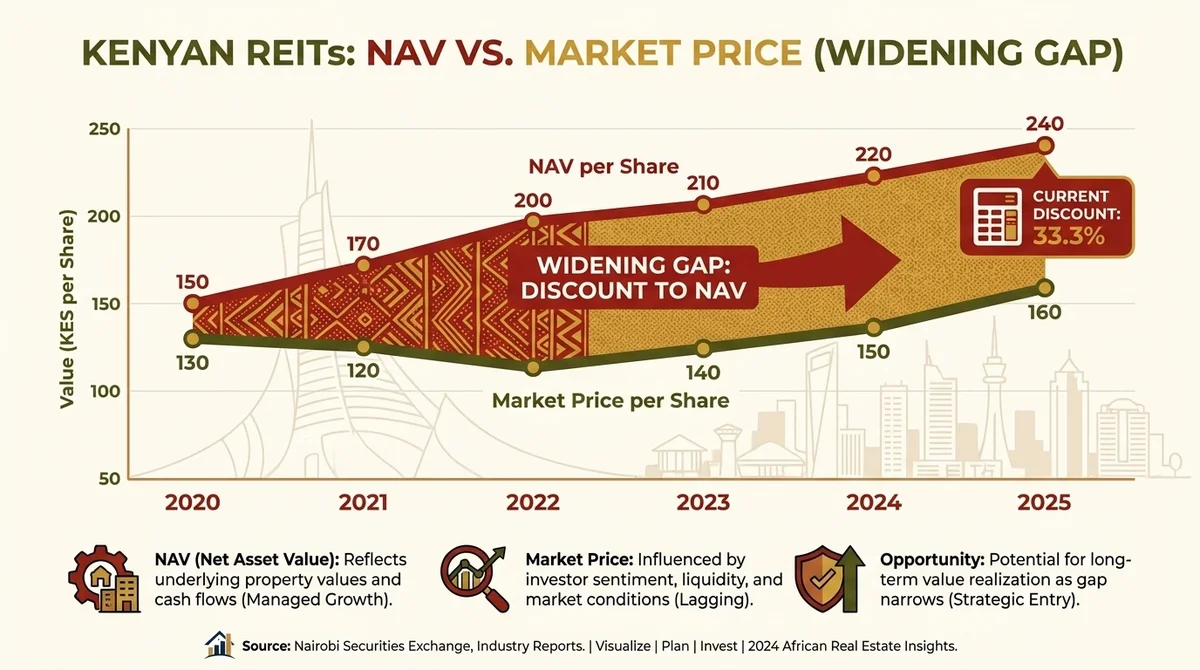
The NAV vs. Market Price Trap: Where Kenyan REITs Stumbled
In the intricate world of Real Estate Investment Trusts (REITs) in Kenya, the disparity between Net Asset Value (NAV) and market price has been a significant stumbling block. This gap often leaves investors puzzled, primarily because the market price of a REIT can deviate significantly from its NAV, which is supposed to reflect the actual value of the underlying real estate assets. According to Rehani Soko market intelligence, this discrepancy has been a persistent issue, affecting investor confidence and liquidity in the Nairobi real estate market.
Cost Breakdown of Typical REIT Investment
💰Initial Investment
Estimated Cost (KES)500,000
Impact on NAV vs. Market PriceBase cost for asset acquisition
💰Management Fees
Estimated Cost (KES)20,000 annually
Impact on NAV vs. Market PriceReduces overall NAV
💰Market Fluctuation
Estimated Cost (KES)Variable
Impact on NAV vs. Market PriceCauses NAV and price divergence
One of the main reasons for this divergence is market sentiment, which can drive prices below the NAV, even when the underlying assets are performing well. For instance, during periods of economic uncertainty or when interest rates are high, investors might shy away from real estate investments, causing the market prices of REITs to drop. According to the Central Bank of Kenya, the interest rates have been fluctuating, impacting investor sentiment and, consequently, the market price of REITs.
Moreover, the lack of liquidity in the secondary market for REITs exacerbates this issue. Unlike physical properties, which can be sold directly through platforms like Rehani Soko, REITs often struggle with limited buyer interest, making it challenging for investors to exit their positions without impacting the price.
The Nairobi Real Estate Shift: Physical Assets Over Public Markets
This NAV versus market price trap highlights the importance of analytical insight when investing in REITs. As transaction patterns confirm, the ability to navigate these discrepancies is crucial for achieving optimal returns. For those interested in more stable investments, exploring physical assets through properties in Nairobi might offer a more transparent and direct investment route. By understanding these dynamics, investors can approach the Kenyan real estate market with a clear process that removes the uncertainty often associated with REIT investments.
In Nairobi’s dynamic real estate market, understanding the nuances of each neighborhood is crucial for informed investment decisions. PropTech innovations are transforming this landscape by offering digital tools that enhance transparency and provide comprehensive data analysis. According to Rehani Soko market intelligence, investors can now access detailed insights into property values, rental yields, and market trends in real-time, eliminating much of the guesswork traditionally associated with real estate investments.
One of the key benefits of these digital tools is their ability to aggregate and analyze a multitude of data points. For instance, Rehani Soko analytics reveal that Westlands, Kilimani, and Karen neighborhoods consistently show strong rental yields, driven by demand from professionals and expatriates. This data-driven approach empowers investors with critical insights into potential returns and neighborhood viability, fostering confidence in decision-making.
As shown in the table above, Westlands leads with a notable 7.5% rental yield, reflecting its attractiveness to investors seeking stable returns. This digital transparency not only supports informed investments but also highlights areas with growth potential, such as Kilimani, which shows a 4.9% market growth rate, according to Rehani Soko data.
For those looking to explore Nairobi’s real estate opportunities further, leveraging these digital tools is essential. Prospective investors can browse all properties to discover options across various neighborhoods. Additionally, using the mortgage calculator can aid in financial planning, ensuring investments align with individual financial goals.
In conclusion, PropTech innovations are revolutionizing how investors approach Nairobi's real estate market by providing the transparency and data needed to make informed, confident decisions. As digital tools continue to evolve, they promise to further enhance the efficiency and effectiveness of real estate investments in the region.
Unlocking True Liquidity: How Platforms Create Digital Secondary Markets
In Nairobi's evolving real estate landscape, the concept of liquidity has been a persistent challenge, particularly when relying solely on traditional investment vehicles such as Real Estate Investment Trusts (REITs). However, the emergence of digital platforms is reshaping how investors access and trade property assets, creating digital secondary markets that offer unprecedented liquidity.
Summary of Key Neighborhood Data
📊Westlands
Average Rental Yield (%)7.5
Market Growth (%)5.2
📊Kilimani
Average Rental Yield (%)6.8
Market Growth (%)4.9
📊Karen
Average Rental Yield (%)6.3
Market Growth (%)4.5
Digital platforms like Rehani Soko are at the forefront of this transformation, providing a transparent and efficient marketplace for property transactions. According to Rehani Soko market intelligence, these platforms enable investors to access a broader spectrum of properties, from residential units in Kilimani to commercial spaces in Westlands, thus diversifying their portfolios with ease. By leveraging technology, these platforms facilitate faster transactions and reduce the barriers typically associated with buying and selling property.
One of the key advantages of digital secondary markets is the ability to fractionalize property ownership. This innovative approach allows investors to purchase shares of a property rather than the entire asset, significantly lowering the entry barrier. As a result, more investors can participate in the real estate market, increasing the overall liquidity. Additionally, according to the Kenya National Bureau of Statistics (KNBS), the real estate sector in Nairobi has seen a growth rate of 5% over the past year, underscoring the increasing demand for more flexible investment options.
Moreover, digital platforms provide robust data analytics tools that enhance decision-making. By utilizing real-time data, investors can better assess market trends and property values, leading to more informed investment choices. This analytical prowess not only boosts investor confidence but also ensures a more dynamic and responsive market environment.
For those interested in exploring these opportunities, Rehani Soko offers a range of resources, including a mortgage calculator and the ability to browse all properties. These tools empower investors to navigate the digital real estate market with confidence, ensuring that liquidity is no longer a distant aspiration but a tangible reality.
The Diaspora Playbook: Safely Managing Your PropTech Portfolio
For the diaspora investor eyeing Nairobi's bustling real estate market, PropTech offers a compelling gateway to manage properties efficiently and with greater liquidity. As the city continues to grow, driven by urbanization and a burgeoning middle class, the opportunities for investment are ripe. However, understanding how to navigate this landscape securely is crucial.
Investment in PropTech platforms like Rehani Soko can provide a clear process that removes the uncertainty typically associated with real estate transactions. These platforms utilize advanced analytics to provide investors with comprehensive market data. For instance, Rehani Soko market data shows that Nairobi's property prices have steadily increased by an average of 5% annually over the past three years. This consistent growth, coupled with robust rental yields, makes the city an attractive destination for investment.
One of the key advantages of PropTech is the ability to digitally vet neighborhoods. This feature not only enhances transparency but also empowers investors to make informed decisions based on transaction patterns that confirm market viability. By using data-driven insights, investors can better assess the potential of various areas within Nairobi, ensuring their portfolios are both diverse and secure.
For diaspora investors keen on tapping into Nairobi's real estate market, leveraging PropTech can be a game-changer. The process is not without its challenges—such as mastering new technologies and ensuring cybersecurity—but the potential rewards are significant. To explore available properties and manage your investments seamlessly, visit Rehani Soko for more information. Additionally, for personalized assistance and queries, use the Ask Hani tool. By embracing PropTech, you can confidently navigate the dynamic Nairobi real estate market and ensure your investments are secure and profitable.
Conclusion: Navigating Nairobi's Real Estate Liquidity with PropTech
The integration of PropTech into Nairobi's real estate market offers a promising solution to longstanding liquidity challenges. As we explore this dynamic landscape, here are five key takeaways:
Enhanced Accessibility: PropTech platforms like Rehani Soko are democratizing access to real estate investments, making it easier for both local and diaspora investors to participate in the market.
Data-Driven Decisions: According to Rehani Soko property analytics, using data analytics tools enables investors to make informed decisions, reducing uncertainty and risk.
Increased Liquidity: PropTech innovations are improving market liquidity by facilitating faster and more transparent transactions, as Rehani Soko market intelligence indicates.
Cost Efficiency: Streamlined processes reduce transaction costs, benefitting both buyers and sellers by enhancing overall market efficiency.
Future Growth Potential: With continuous technological advancements, the potential for further growth and transformation in Nairobi's real estate sector remains significant.
Important Disclaimer
This article is intended for informational purposes only and does not constitute financial advice. Please consult with a financial advisor or legal expert before making investment decisions.
Related Resources
For more information on real estate opportunities in Nairobi or to explore property options, visit properties in Nairobi. To assess your mortgage options, check out our mortgage calculator or get a personalized quote here. For any legal or financial queries, reach out using Ask Hani.
By leveraging these resources, you can stay informed and make strategic decisions in Nairobi's evolving real estate market.
Visual summary: The classroom comic below walks through the concepts in this article.
📖
Hani Explains It
Page 1 of 2
Frequently Asked Questions
The trend report highlights several key developments in Nairobi's real estate market, particularly how PropTech is addressing liquidity challenges. According to Rehani Soko market intelligence, there is a growing integration of technology in property transactions, making the process more transparent and efficient. This shift is vital in a city where liquidity has historically been a significant barrier for both buyers and sellers. Real estate technology platforms are providing innovative solutions like digital property listings and virtual tours, which are enhancing the accessibility of real estate information. Furthermore, these platforms are employing data analytics to offer insights into market trends and property valuations, helping investors make informed decisions. This evolution is indicative of Nairobi's real estate market adapting to global standards, improving investor confidence, and stimulating market activity.