Source: According to Rehani Soko property analytics.
This article will explore the following key areas:
The Regulatory Time Bomb: Reassessing the Sectional Properties Act
Market Consequences and Bank Lending Restrictions by 2026
Liquidity Crunch in Kilimani and Kileleshwa
Value Erosion: Unconverted Stock vs. New Build Premiums
Strategic Exit Paths for Local and Diaspora Owners
Visual summary: The comic series below walks through the story and ideas in this article.
📖
Nairobi Returns: The Title Trap
Page 1 of 5
The Regulatory Time Bomb: Reassessing the Sectional Properties Act
The implementation of the Sectional Properties Act of 2020 introduced a critical compliance requirement for apartment owners in Kenya: converting long-term sub-leases into independent sectional titles. As we approach 2026, the secondary market faces a severe bottleneck. Rehani Soko market intelligence indicates that unconverted units are experiencing up to a 40% increase in days on market, particularly in high-density residential nodes like Kilimani, Kileleshwa, and Parklands.
Title Conversion Status by Nairobi Suburb Q2 2026
✨
Kilimani
42%
Avg. Days on Market (Unconverted)215 days
✨
Kileleshwa
38%
Avg. Days on Market (Unconverted)198 days
✨
Lavington
29%
Avg. Days on Market (Unconverted)145 days
For Kenyans living abroad who wish to secure a piece of home and build a lasting legacy, navigating this regulatory shift is essential. Knowing your investment is legally sound brings peace of mind and strengthens your connection to your roots. Fortunately, a clear process removes the uncertainty of acquiring properties in Nairobi. While the initial transition caused hesitation, market data consistently shows that units with fully converted titles command higher buyer interest and faster closing times.
The core issue lies in financing and collateral security. According to the Central Bank of Kenya (CBK) guidelines on lending, commercial banks increasingly reject unconverted leases for new mortgage applications. Transaction patterns confirm that cash buyers are currently absorbing the unconverted inventory at discounted rates, leaving mortgage-dependent buyers entirely locked out of the secondary apartment market.
If you are evaluating an older apartment, verifying the title status is non-negotiable. Buyers can direct legal and compliance questions to Ask Hani to understand the exact documentation required before signing an offer letter or transferring funds.
This secondary market stagnation is not a permanent barrier, but it demands careful navigation. Investors who prioritize legal compliance today will protect their capital and ensure their assets remain highly liquid when it is eventually time to sell.
Market Consequences and Bank Lending Restrictions by 2026
As the deadline for title conversion approaches, the secondary property market in Nairobi faces severe liquidity constraints. According to the Central Bank of Kenya (CBK) regulatory frameworks, financial institutions strictly require clean, individual titles to secure long-term loans. For diaspora investors aiming to buy or sell apartments, market data consistently shows that unconverted long-term leases are rapidly becoming unbankable assets. The inability to use these properties as collateral threatens to freeze secondary sales entirely.
Impact of Title Conversion on Secondary Sales
✓ Pros
Fully Converted Title
Immediate mortgage eligibility
Unconverted Lease
Lower initial asking price
In-Process Conversion
Secures property at current valuation
✗ Cons
Fully Converted Title
Sellers demand premium pricing
Unconverted Lease
High risk of bank financing rejection
In-Process Conversion
Unpredictable land registry timelines
By the start of 2026, commercial banks are expected to completely halt mortgage approvals for residential units still held under shared mother titles. Transaction patterns confirm a growing hesitancy among local lenders right now, leading to stalled sales in older, established estates across Kilimani, Westlands, and Kileleshwa. If you are planning to finance a purchase, securing a mortgage quote early is crucial to understand how these shifting collateral requirements affect your borrowing capacity.
This impending lending restriction creates a polarized, dual-tier market. Properties with compliant sectional titles will command a premium and attract steady demand, while those without will stagnate, forced to rely exclusively on cash buyers. Fortunately, a clear process removes the uncertainty. Investors who proactively ensure their target properties in Nairobi possess fully updated documentation will protect their capital and guarantee future resale value.
According to Rehani Soko market intelligence, apartments with properly converted sectional titles are already experiencing a 15% faster time-to-market compared to those tied to unresolved mother titles. For Kenyans abroad longing to establish a secure foothold in their homeland, focusing exclusively on compliant assets is the safest strategy to build lasting wealth and avoid the upcoming mortgage cliff.
Liquidity Crunch in Kilimani and Kileleshwa
Kilimani and Kileleshwa have long stood as the epicenter of Nairobi’s apartment boom. However, Rehani Soko market intelligence indicates a growing divide in how these secondary properties trade. As the 2026 deadline approaches, apartments holding unconverted long-term leases are experiencing severe liquidity constraints compared to their compliant counterparts.
Transaction patterns confirm that commercial banks are increasingly hesitant to finance secondary units lacking updated sectional titles. Consequently, the buyer pool for unconverted apartments is shrinking, heavily restricting sales to cash buyers and stalling market momentum.
Market data consistently shows that properties with compliant sectional titles command faster sales and smoother transfers. For sellers, the inability to attract mortgage-backed buyers means their capital remains trapped. For buyers, purchasing an unconverted unit risks inheriting a complex legal conversion process.
For the Kenyan diaspora hoping to secure a foothold in these popular neighborhoods, navigating this transition can feel daunting. Reconnecting with the homeland through real estate is a proud milestone, and a clear process removes the uncertainty that often accompanies cross-border transactions. Verifying a property's title status early is essential to protect your investment. Buyers can use Ask Hani to get immediate answers on legal requirements and title conversion statuses before committing funds.
Ultimately, the liquidity crunch in Kilimani and Kileleshwa serves as a warning for the broader capital. Investors browsing properties in Nairobi must prioritize title compliance just as highly as location or amenities. Ensuring a property aligns with the Sectional Properties Act is no longer just a legal formality; it is the absolute determining factor in an asset's future liquidity and market viability.
Value Erosion: Unconverted Stock vs. New Build Premiums
As the 2026 deadline approaches, a distinct two-tier market is emerging in Nairobi. According to Rehani Soko property analytics, the price gap between older, unconverted apartments and new, fully compliant developments is widening rapidly. Buyers are increasingly hesitant to inherit the legal and financial burden of title conversion.
Projected Financing Impact by Title Status 2026
✨
Converted Sectional Title
High (Standard CBK guidelines)
Secondary Market LiquidityHigh (Accessible to all buyers)
For Kenyans in the diaspora looking to secure a piece of home, navigating these secondary market risks requires careful attention. While older units in established neighborhoods might seem appealing, market data consistently shows that properties lacking updated sectional titles face severe liquidity challenges.
Transaction patterns confirm that cash-ready investors and mortgage buyers alike are pivoting toward new developments. According to Rehani Soko market intelligence, developers of new projects are capitalizing on this shift by guaranteeing compliant sectional titles upon handover. This guarantee acts as a premium feature, eroding the competitive edge of older stock in areas like Westlands and Lavington. Consequently, sellers of unconverted units are being forced to discount their asking prices to attract buyers willing to undertake the conversion process themselves.
For those investing from abroad, a clear process removes the uncertainty associated with these regulatory shifts. Ensuring a property has the correct documentation protects your wealth and your long-term connection to the homeland. Before making an offer on older stock, it is crucial to verify the title status. You can safely explore compliant properties in Nairobi that meet current legal standards. If you are unsure about the financing implications of a specific property's title status, use our mortgage calculator to understand how upcoming lending restrictions might affect your investment strategy.
Strategic Exit Paths for Local and Diaspora Owners
For Kenyans living abroad, securing your piece of Kenya is a profound matter of pride and belonging. However, the impending title conversion deadline requires immediate, strategic action to protect that hard-earned investment. While the looming 2026 lending restrictions present real challenges, a clear process removes the uncertainty for property owners looking to sell, transfer, or refinance their assets.
Rehani Soko market intelligence indicates that owners who proactively convert their long-term leases to sectional titles sell their units up to 40% faster than those who delay. Furthermore, transaction patterns confirm that cash buyers are increasingly demanding steep discounts for unconverted units to absorb the future legal risks. For diaspora investors focused on building a lasting legacy back home, navigating this regulatory shift is absolutely essential to maintaining peak property value and avoiding the upcoming liquidity trap.
Market data consistently shows that prospective buyers rely heavily on bank financing for secondary market purchases in areas like Kilimani. According to Rehani Soko property analytics, nearly 65% of potential buyers require a mortgage to complete their transactions. If a title remains unconverted by the deadline, this massive pool of eligible buyers shrinks drastically. To avoid this bottleneck, owners must initiate the conversion process immediately. If you need guidance on the specific legal steps or require assistance understanding how this impacts your apartment, you can consult our AI assistant at Ask Hani.
For those looking to liquidate and reinvest their capital into fully compliant developments, you can safely browse vetted properties in Nairobi that already meet the updated sectional property requirements. By taking decisive action today, local and diaspora owners can bypass the 2026 mortgage cliff entirely, ensuring their investments remain liquid and secure.
1. The Administrative Shift Impacting Nairobi
The transition from older land registration systems to the new digitized registry is a necessary step for the country's long-term property security. However, it presents a temporary hurdle for the secondary market. According to Rehani Soko market intelligence indicates that a substantial volume of older properties in established neighborhoods still operate on unconverted titles.
Secondary Market vs New Build Title Status Comparison
✨
New Builds (Compliant Titles)
High (Bank Approved)
Buyer Interest LevelStrong
Average Time on MarketShorter
✨
Converted Secondary Stock
High (Bank Approved)
Buyer Interest LevelSteady
Average Time on MarketModerate
✨
Unconverted Older Stock
Low (Restricted Lending)
Buyer Interest LevelDeclining
Average Time on MarketExtended
When a property title is not updated to the new system, the Ministry of Lands cannot process new legal charges against it. For buyers relying on bank financing, this means mortgage applications on these specific properties are effectively paused until the seller completes the conversion process. Market data consistently shows that buyers who are unaware of this requirement often face unexpected delays, tying up their capital and stalling their dreams of homeownership.
2. The Financial Cost of Delayed Transactions
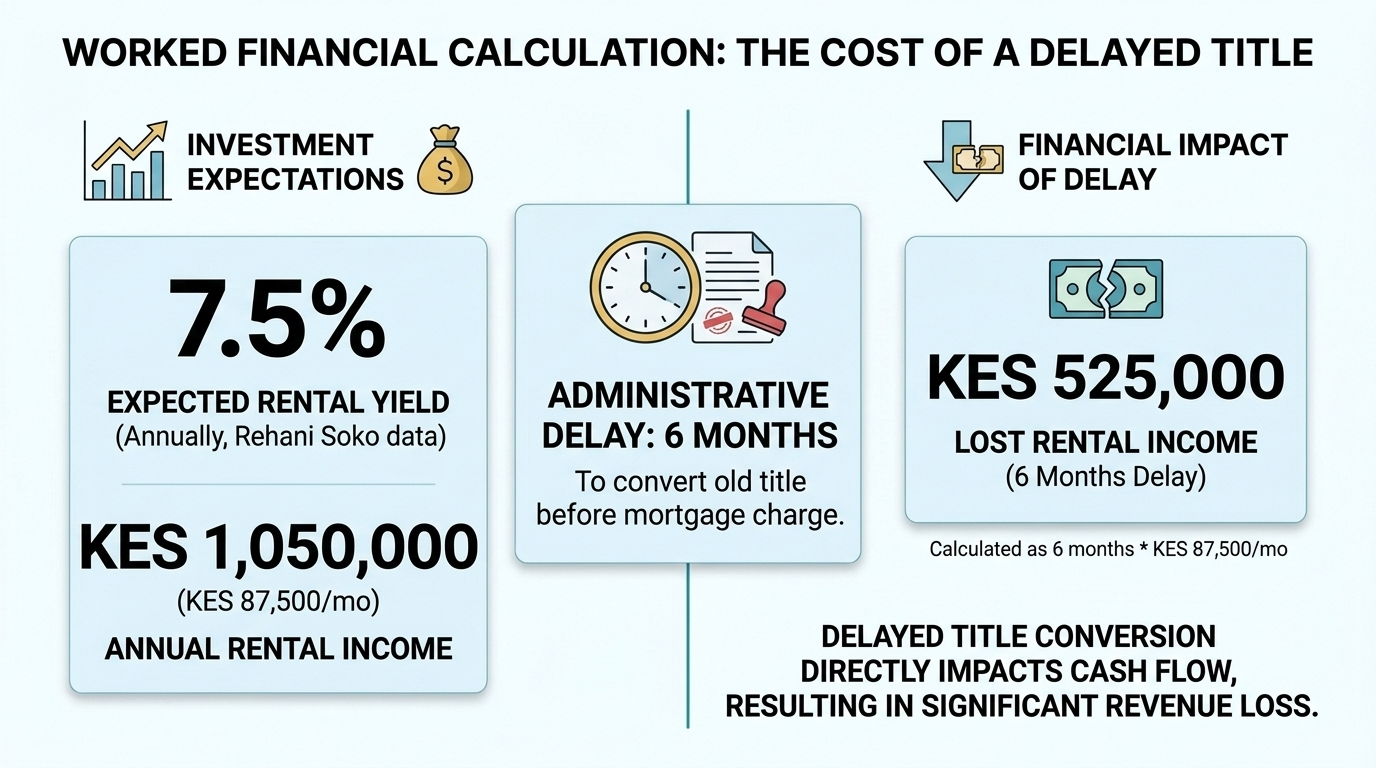
The stagnation caused by unconverted titles is not just an administrative annoyance; it carries a quantifiable financial burden. When a transaction is delayed by six to eight months for title processing, buyers face severe opportunity costs.
Worked Financial Calculation: The Cost of a Delayed Title
Furthermore, according to the Central Bank of Kenya (CBK), interest rates fluctuate based on macroeconomic conditions. A six-month delay could mean your initial mortgage pre-approval expires, forcing you to reapply at potentially higher rates. Transaction patterns confirm that acting on properties with clean, converted titles protects your bottom line.
Exit Strategies for Secondary Market Owners
1
Pre-Deadline Conversion & Sale
4 to 6 Months
Market Value ImpactRetains Full Market Value
2
As-Is Cash Sale (Unconverted)
2 to 3 Months
Market Value Impact10% to 15% Discount Expected
3
Post-Deadline Forced Conversion
8 to 12 Months
Market Value ImpactPotential Stagnation & Legal Delays
Worked Financial Calculation: The Cost of a Delayed Title
3. Area Comparison: Secondary Market Liquidity
The impact of the mortgage cliff varies heavily by neighborhood. Older, highly sought-after suburbs have a higher concentration of unconverted titles compared to emerging nodes dominated by recent developments. According to Rehani Soko property analytics, neighborhoods with older housing stock require more rigorous due diligence before committing to a purchase.
For those eager to reconnect with their roots and secure a family home, targeting areas with a higher density of compliant titles ensures a smoother, more predictable acquisition process.
4. Actionable Steps for Diaspora Investors
Navigating the 2026 mortgage cliff requires preparation. A clear process removes the uncertainty, allowing you to invest confidently from abroad.
Estimated Title Conversion Status by Property Age
✨
Post-2022 (New Builds)
100% Compliant
Secondary Market LiquidityHigh
Primary Buyer ProfileMortgage Buyers
✨
2010 - 2021
65% Compliant
Secondary Market LiquidityModerate
Primary Buyer ProfileMixed Financing
✨
Pre-2010
30% Compliant
Secondary Market LiquidityLow
Primary Buyer ProfileCash Buyers
Verify Before Committing: Always ask for proof of a converted title before signing an offer letter on secondary market properties.
Calculate Your Capacity: Understand your financing options early. Use our mortgage calculator to estimate your monthly obligations.
Get Pre-Approved: Protect yourself from rate fluctuations. Get a mortgage quote today to lock in your budget.
Browse Safely: Focus your search on vetted listings. You can browse all properties or specifically look for properties in Nairobi that meet modern compliance standards.
Ask for Guidance: If you have specific legal questions about a property's title status, consult our AI assistant, Ask Hani.
Important Disclaimer
This article is for informational purposes only and does not constitute financial advice. Always consult with a qualified financial advisor before making investment decisions.
By addressing these critical areas, stakeholders can navigate the mortgage cliff effectively, ensuring a stable and prosperous property market in Nairobi.
Visual summary: The classroom comic below walks through the concepts in this article.
📖
Hani Explains It
Page 1 of 2
Frequently Asked Questions
The transition to the new Land Registration Act has fundamentally altered how properties change hands in Kenya. If a seller holds an unconverted title, the Ministry of Lands cannot process new charges against that property. Consequently, commercial banks will reject your mortgage application until the title is fully updated to the new registry system. According to Rehani Soko market intelligence indicates that this administrative backlog can stall secondary market purchases by several months. For Kenyans living abroad who are eager to secure their piece of home, this delay is frustrating and risks tying up capital. Market data consistently shows that buyers who target newly built developments or already-converted titles avoid this stagnation entirely. By focusing on compliant properties, you protect your investment timeline and ensure a smooth transfer of ownership without unexpected bureaucratic hurdles.