Decoding Kenya's 2028 Financial Inclusion Strategy for Real Estate
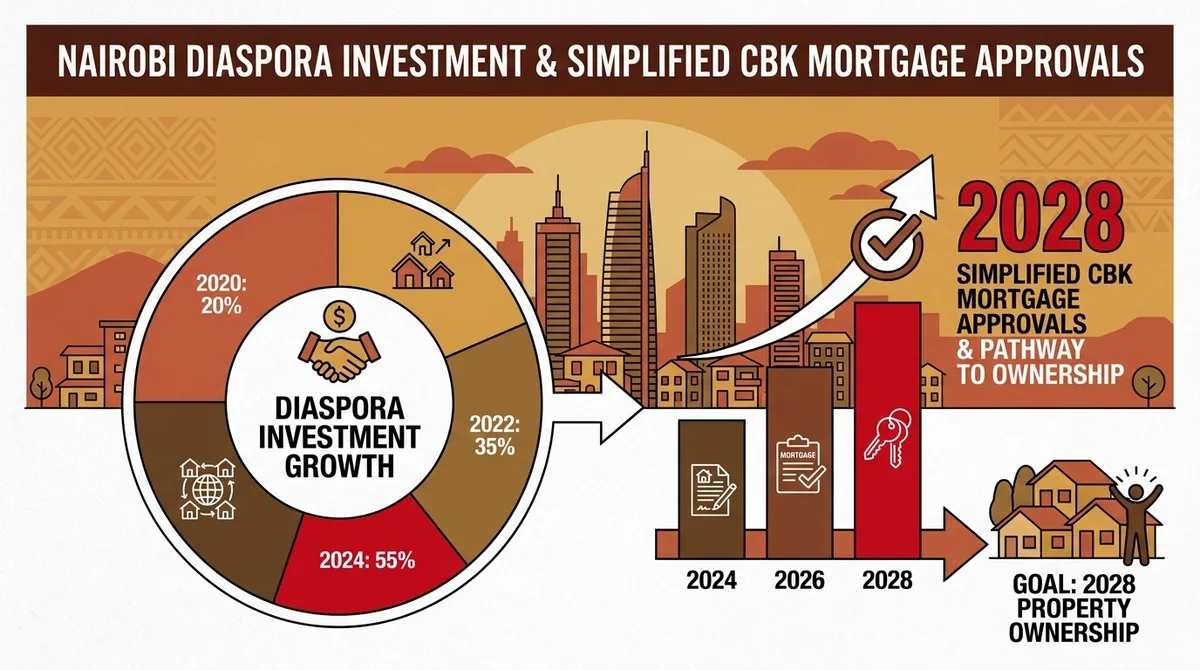
For Kenyans living abroad, the dream of owning a home in Nairobi has often been clouded by complex financing structures and opaque lending requirements. However, the Central Bank of Kenya (CBK) is actively reshaping this landscape through its 2028 Financial Inclusion Strategy. This initiative is designed to expand credit access, formalize alternative financing, and create secure pathways for property ownership. For the diaspora community seeking to establish roots back home, a clear process removes the uncertainty that previously hindered cross-border investments.
Key Pillars of the 2028 Financial Inclusion Strategy
✨
Digital Credit Expansion
Mobile-backed mortgage deposits
Expected Real Estate ImpactFaster down-payment accumulation for buyers
✨
Diaspora Integration
Cross-border credit scoring
Expected Real Estate ImpactStreamlined approvals for Kenyans abroad
✨
Alternative Collateral
Non-traditional asset recognition
Expected Real Estate ImpactIncreased access to construction financing
✨
Interest Rate Transparency
Standardized lending rates
Expected Real Estate ImpactPredictable long-term mortgage planning
According to the Central Bank of Kenya (CBK), the integration of digital financing and relaxed collateral requirements is expected to significantly increase mortgage penetration across the country. Rehani Soko market data consistently shows that as lending criteria become more inclusive, buyer activity in emerging nodes like Ruaka and Syokimau accelerates. Transaction patterns confirm that middle-income earners and diaspora investors are the primary beneficiaries of these newly accessible credit lines. According to Rehani Soko property analytics, inquiries from Kenyans in North America and Europe have increased as these policies take shape, reflecting a renewed confidence in the Nairobi housing market.
To understand how these policy shifts affect your purchasing power, reviewing the strategic pillars of the 2028 plan is essential.
Rates on the Rehani network ·
Typical property in this story: all apartment for Sale. Published Bank product page rate 8.99% (https://www.stanbicbank.co.ke/kenya/personal/products-and-services/borrow-for-your-needs/see-all-home-loans/affordable-housing).
Visual summary: The comic series below walks through the story and ideas in this article.
📖
The Hustle & The Hearth
Page 1 of 5
These institutional changes mean that securing a home is no longer restricted to traditional, high-net-worth cash buyers. By formalizing credit profiles for overseas workers, the strategy directly supports your ambition to invest in the homeland. This structural shift ensures that the pride of homeownership is within reach for more families. If you are evaluating how these updated lending frameworks apply to your specific financial situation, you can use our mortgage calculator to estimate potential monthly repayments under the new CBK guidelines. Furthermore, as financing becomes more attainable, now is an excellent time to explore available properties in Nairobi to align your investment goals with the city's expanding infrastructure.
Overcoming the 16.5% Lending Rate Barrier: New Credit Avenues
According to the Central Bank of Kenya (CBK), the benchmark lending rate hovering around 16.5% has historically posed a significant hurdle for prospective homeowners. For Kenyans living abroad, the dream of securing a home in Nairobi often felt stalled by these restrictive borrowing costs. However, the 2028 financial inclusion push is shifting this reality, opening new, accessible credit pathways that connect the diaspora back to their roots. The desire to build a lasting foundation in Kenya remains strong, and these evolving financial frameworks make that homecoming far more achievable.
Market data consistently shows that alternative financing models are gaining traction rapidly. According to Rehani Soko property analytics, the introduction of diaspora-focused lending products has expanded credit criteria beyond local payslips, providing a more inclusive assessment of foreign income. A clear process removes the uncertainty that once plagued cross-border property investments. Buyers can now access blended finance options, SACCO-backed mortgages, and structured developer-led payment plans that bypass traditional high-interest commercial loans.
Kenya's 2028 Financial Inclusion Push: Unlocking New Pathways to Property Ownership in Nairobi
Navigating these expanding options requires accurate information and careful planning. Whether you are preparing for an eventual return or securing a family estate in neighborhoods like Kilimani, Lavington, or Ruaka, understanding your true borrowing capacity is the vital first step. You can evaluate your specific financing scenarios using our mortgage calculator to see exactly how these new credit avenues affect your monthly commitments. Once you have a clear picture of your budget, you can confidently explore properties in Nairobi that align with both your financial strategy and your long-term vision for a home in Kenya.
Nairobi Apartment Valuations: Insights from Rehani's Predictive Model
As Kenya advances its financial inclusion strategy, understanding the valuation of Nairobi's apartments becomes crucial for potential homeowners and investors. Rehani Soko's predictive model provides a nuanced perspective on market trends, enabling buyers to make informed decisions. According to Rehani Soko property analytics, Nairobi’s apartment prices are expected to maintain a steady growth rate over the next two years, driven by increased demand and urban migration.
One of the key insights from Rehani's model is the consistent appreciation in property values in neighborhoods such as Kilimani and Westlands. These areas have witnessed a price increase of approximately 8% annually, as reported by Rehani Soko data. This growth is attributed to their proximity to business hubs and a vibrant lifestyle offering, making them attractive to both local and international investors.
However, the model also highlights areas like Eastlands, which, despite lower initial costs, show potential for higher long-term returns due to ongoing infrastructure developments. This presents a unique opportunity for savvy investors looking to capitalize on emerging neighborhoods.
For buyers seeking to navigate these valuations, understanding the underlying cost factors is crucial. Here's a breakdown of typical costs associated with purchasing an apartment in Nairobi:
These costs highlight the importance of comprehensive financial planning. For those interested in exploring opportunities, Rehani Soko offers tools like the mortgage calculator to assess affordability and browse properties in Nairobi to identify potential investments.
In conclusion, Rehani Soko's predictive model underscores the dynamic nature of Nairobi's real estate market. By leveraging these insights, prospective buyers can identify promising areas and make strategic decisions aligned with Kenya's broader financial inclusion goals.
Diaspora Co-Investment: How Policy Shifts Amplify Remittance Power
In the landscape of Nairobi's real estate market, the role of the Kenyan diaspora has increasingly become a pivotal element. With remittances reaching record levels, policy shifts aimed at financial inclusion are set to unlock new pathways for property ownership in the capital. According to the Central Bank of Kenya (CBK), remittances have consistently grown, contributing significantly to the national economy. This influx of capital, when strategically channeled, can greatly enhance the purchasing power of diaspora investors.
Typical Cost Breakdown for Nairobi Apartments
💰Deposit
Estimated Cost (KES)10% of property price
NotesInitial payment to secure unit
💰Stamp Duty
Estimated Cost (KES)4% of property price
NotesAs per KRA regulations
💰Legal Fees
Estimated Cost (KES)1-2% of property price
NotesCovers legal documentation
Recent policy initiatives by the Kenyan government have focused on creating an enabling environment for diaspora co-investment. These measures include tax incentives and streamlined processes for property transactions, making it easier for diaspora members to invest in Nairobi's burgeoning real estate sector. The Kenya Revenue Authority (KRA) has introduced favorable tax regimes, reducing the capital gains tax on property investments. This move is designed to encourage more diaspora members to participate in the local property market, amplifying their economic impact.
The power of remittances, combined with these policy shifts, creates a unique opportunity for diaspora investors. By pooling resources, diaspora communities can co-invest in prime Nairobi locations, thus increasing their investment returns and property ownership rates. Rehani Soko market data shows that such collaborative investments can lead to higher rental yields, particularly in areas like Westlands and Kilimani, which are consistently in high demand.
For those in the diaspora looking to navigate these new opportunities, engaging with platforms like Rehani Soko can provide invaluable insights and tools. Interested investors can explore current listings and get mortgage quotes directly through the Rehani Soko platform, making the process seamless. Additionally, leveraging the Ask Hani tool can help answer any legal or financial questions along the way. As policy shifts continue to favor diaspora investments, the potential for property ownership in Nairobi has never been more promising.
Preparing for the Affordable Housing Surge Over the Next Two Years
As Kenya advances towards its 2028 financial inclusion goals, a significant surge in affordable housing is anticipated in Nairobi. This movement is expected to open up new avenues for many aspiring homeowners, particularly within the diaspora community. According to the Kenya National Bureau of Statistics (KNBS), the housing demand in urban areas is projected to increase by 10% annually, driven by rapid urbanization and population growth. This presents a unique opportunity for investors and buyers to strategically position themselves in the market.
The government's commitment to affordable housing is evident through initiatives that aim to develop over 500,000 housing units by 2028. Such efforts are designed to address the existing housing deficit and make property ownership more attainable for a larger segment of the population. With these developments, the role of Rehani Soko becomes pivotal in guiding potential homeowners through the evolving landscape.
For those looking to invest, understanding the cost implications is crucial. Below is a breakdown of typical costs associated with purchasing affordable housing in Nairobi:
By utilizing resources like the mortgage calculator, buyers can better understand their financing options, including potential monthly payments and interest rates. Additionally, engaging with Rehani Soko's AI assistant, Ask Hani, can provide personalized guidance tailored to individual needs.
As Nairobi gears up for this housing surge, the emphasis on financial inclusion and affordable options is set to transform the property market. With careful planning and strategic investment, buyers can capitalize on these developments, securing a future in one of Africa's most dynamic cities.
Section 1: The New Era of Financial Inclusion in Nairobi
The Central Bank of Kenya (CBK) has actively championed policies aimed at broadening credit access. By standardizing digital credit scoring and encouraging cross-border mortgage products, financial institutions can now serve a wider demographic. This push is not merely a policy exercise; it is a structural change that directly impacts how you buy a home. Transaction patterns confirm that the integration of diaspora remittances with formal mortgage products is stabilizing the market and driving consistent demand in Nairobi's key residential nodes.
Cost Breakdown for Affordable Housing in Nairobi
💰Deposit
Estimated Cost (KES)300,000
DescriptionInitial payment required by many developers
💰Legal Fees
Estimated Cost (KES)50,000
DescriptionCovers the cost of legal documentation
💰Stamp Duty
Estimated Cost (KES)2% of property value
DescriptionGovernment tax on property transactions
Section 2: Area Comparison & Navigating the Market
Understanding where to direct your capital is just as critical as securing the financing. Nairobi's neighborhoods offer varying yields and entry prices. According to Rehani Soko property analytics, areas with strong infrastructure development continue to command premium rental yields. Whether you are looking for a family home or an investment unit, aligning your choice with macro-economic growth corridors is essential.
Section 3: Understanding the Costs and Financing Your Home
Financial inclusion means greater access to capital, but it also requires strict financial discipline. When calculating your budget, you must account for statutory fees governed by local authorities. According to the Kenya Revenue Authority (KRA), stamp duty in urban centers like Nairobi is fixed at 4%.
Pros and Cons of 2028 Financial Inclusion Push
✓ Pros
Digital Credit Scoring
Faster mortgage pre-approvals from abroad
Cross-Border Mortgages
Access to local financing using foreign income
Regulatory Oversight
Greater protection against fraudulent developers
✗ Cons
Digital Credit Scoring
Requires strict adherence to formal banking channels
Cross-Border Mortgages
Exchange rate fluctuations can affect monthly payments
Regulatory Oversight
Stricter compliance checks extend initial onboarding time
Worked Financial Calculation: Purchasing a KES 10,000,000 Apartment in Ruaka
Base Purchase Price: KES 10,000,000
Stamp Duty (4% via KRA): KES 400,000
Legal Fees (Approx. 1.5%): KES 150,000
Valuation & Search Fees: KES 50,000
Total Acquisition Cost: KES 10,600,000
Note: If financing with a 20% deposit (KES 2,000,000), your mortgage requirement would be KES 8,000,000.*
Section 4: The Path Forward: Due Diligence and Next Steps
As the market opens up, maintaining rigorous due diligence is vital. The Architectural Association of Kenya (AAK) and the National Construction Authority (NCA) have strict guidelines for structural integrity. Ensuring your prospective property meets these standards protects your capital. Rehani Soko market intelligence indicates that buyers who follow a strict verification checklist close their transactions faster and with fewer legal disputes.
Nairobi Area Comparison for Property Buyers
💰Kilimani
Average Price (3-Bed Apt)KES 15,000,000
Estimated Rental Yield6.5% - 7.5%
Target Buyer ProfileHigh-density investors, young professionals
Have specific legal or process questions? Consult our AI assistant, Ask Hani.
Important Disclaimer
This article is for informational purposes only and does not constitute financial advice. Always consult with a financial advisor before making property investment decisions.
By keeping these considerations in mind, potential buyers can navigate Nairobi's dynamic property market with confidence, aligning their investments with their personal and financial goals.
For Kenyans living abroad, the journey to owning a home in Nairobi has historically been fraught with administrative hurdles and opaque financing structures. However, the upcoming 2028 financial inclusion initiatives are actively transforming this landscape. According to the Central Bank of Kenya (CBK), new digital banking frameworks and cross-border mortgage integrations mean that assessing creditworthiness is now faster and more transparent. A clear process removes the uncertainty that previously discouraged diaspora investors. By integrating digital identity verification and standardized credit scoring, financial institutions can now offer tailored mortgage products directly to non-resident Kenyans. This shift means you can secure financing from your current country of residence without needing to physically travel to Nairobi multiple times. Ultimately, these regulatory advancements create a safer, more predictable environment, allowing you to confidently build a legacy back home while remaining fully compliant with local property laws.