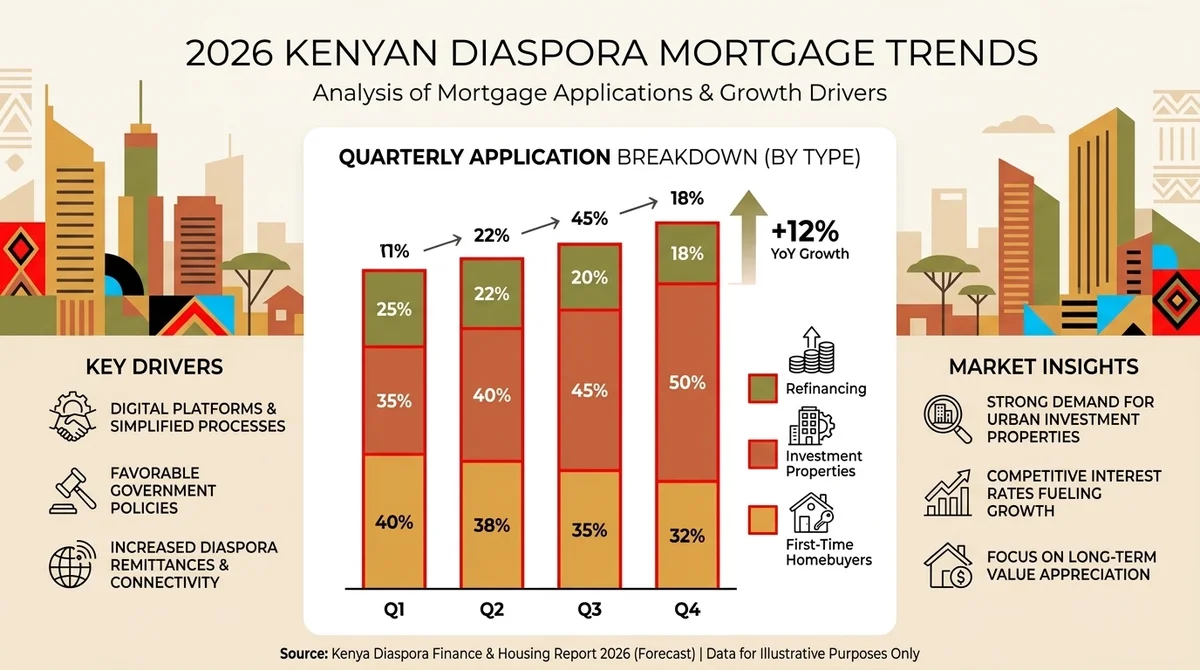
The 2026 Mortgage Landscape in Kenya: What Has Changed?
Essential Bank Requirements for Local Buyers in Nairobi
Diaspora Financing: Securing a Nairobi Property Loan from Abroad
Navigating Off-Plan vs. Ready-to-Move Mortgages in Kenya
Strategies to Improve Your Loan Approval Odds in 2026
To get a customized view of your borrowing capacity, you can use our mortgage calculator today.
Visual summary: The comic series below walks through the story and ideas in this article.
📖
Nairobi Returns: The Paper Trail
Page 1 of 5
The 2026 Mortgage Landscape in Kenya: What Has Changed?
For many Kenyans living abroad, buying a home back in the motherland is a profound step toward securing your roots and building generational wealth. Historically, securing housing finance from thousands of miles away felt complex and opaque. Today, a clear process removes the uncertainty, allowing you to confidently plan your investment.
Preliminary Mortgage Application Checklist
✨
Proof of Income
6 months certified bank statements
Diaspora Buyers12 months foreign bank statements
✨
Identity Verification
KRA PIN and National ID
Diaspora BuyersValid Passport and KRA PIN
✨
Employment Status
Letter from local employer
Diaspora BuyersNotarized contract or tax returns
The 2026 financial environment presents new realities for property buyers. According to the Central Bank of Kenya (CBK), recent adjustments in baseline interest rates have prompted commercial lenders to update their risk assessment criteria. Banks are no longer just looking at your basic payslip; they are examining overall debt-to-income ratios with much greater scrutiny. Lenders now prefer borrowers whose total monthly debt repayments do not exceed 40% of their net income.
However, this shift is not entirely restrictive. Rehani Soko market data consistently shows that Kenyan lenders have modernized their approach to diaspora income. Digital verification tools mean foreign currency earnings are assessed much faster than in previous years. Transaction patterns confirm that buyers who prepare their documentation early experience a significantly smoother approval journey.
Before you begin to look at properties in Nairobi, it is crucial to understand the upfront financial commitments required by local lenders. Beyond the standard 10% to 20% deposit, banks mandate several processing, valuation, and legal fees that must be paid out of pocket before the loan is disbursed.
Understanding these initial costs helps you budget accurately from day one. To see how these specific figures apply to your target property and monthly budget, you can use our official mortgage calculator. Preparing for these exact expenses early ensures that when you finally find the right home, your financing application moves forward without unnecessary delays.
Essential Bank Requirements for Local Buyers in Nairobi
When applying for housing finance in 2026, preparation is your greatest asset. As market data consistently shows, having your documentation meticulously organized speeds up the approval process significantly. Whether you are a local resident or a Kenyan abroad eager to build a lasting foundation back home, understanding these prerequisites is vital. A clear process removes the uncertainty from your financing journey, allowing you to focus entirely on selecting the right home.
Estimated Upfront Mortgage Processing Costs in Kenya
💰Bank Appraisal/Valuation Fee
Estimated Cost (KES)35,000 - 55,000
Paid ToIndependent Valuer
💰Legal & Charge Registration
Estimated Cost (KES)1% - 2% of loan amount
Paid ToAppointed Lawyers
💰Property Stamp Duty
Estimated Cost (KES)4% of property value
Paid ToKenya Revenue Authority
💰Bank Arrangement Fee
Estimated Cost (KES)1% of loan amount
Paid ToLending Institution
Lenders in Nairobi evaluate your financial health through several critical lenses. According to Central Bank of Kenya (CBK) guidelines, financial institutions maintain strict debt-to-income ratio assessments, typically capping your total monthly debt repayments at a maximum of 50% of your net income. Additionally, a clean Credit Reference Bureau (CRB) report is non-negotiable. Rehani Soko market intelligence indicates that buyers with pre-approved financing and cleared CRB status close on properties in Nairobi up to 40% faster than those who delay their financing discussions until after making an offer.
Securing your dream home requires more than just a steady income; it demands proven tax compliance. Financial institutions will rigorously verify your standing with the Kenya Revenue Authority (KRA), making an updated KRA PIN and recent tax returns essential components of your file. For those dreaming of returning to their roots and claiming their space in the city, gathering these documents early prevents heartbreaking delays. Before you begin submitting formal applications to banks, we recommend running your numbers through our mortgage calculator. This helps you understand exactly how current interest rates affect your monthly obligations, ensuring your desired home fits comfortably within your financial reality.
Navigating Housing Finance in Kenya: What Lenders Are Looking For in 2026
Diaspora Financing: Securing a Nairobi Property Loan from Abroad
For Kenyans living abroad, the dream of owning a home back in Nairobi is a powerful anchor to our roots. Reconnecting with the homeland through property ownership brings a deep sense of pride and belonging, but navigating cross-border financing can feel daunting. Fortunately, a clear process removes the uncertainty.
In 2026, lenders have significantly streamlined how they evaluate foreign income. According to the Central Bank of Kenya (CBK), the consistent growth in diaspora remittances has encouraged local banks to create specialized, competitive diaspora mortgage products. However, securing these funds requires specific, well-organized documentation. Lenders now strictly demand certified bank statements from your host country for the last six to twelve months, a valid KRA PIN, and an international credit report from recognized agencies.
Rehani Soko market data consistently shows that diaspora applicants who prepare their foreign tax returns and permanent employment contracts in advance experience a 40% faster approval rate. Furthermore, transaction patterns confirm that banks are heavily scrutinizing debt-to-income ratios across both jurisdictions, ensuring your foreign living expenses do not compromise your ability to service a Kenyan loan.
If you are ready to take the next step toward securing your Nairobi home, you can easily get a mortgage quote tailored specifically to your international income profile. Lenders want to see long-term stability, so maintaining a spotless credit record in your current country of residence is absolutely non-negotiable.
For specific legal questions regarding cross-border purchases, power of attorney, or dual taxation concerns, you can consult our AI assistant at Ask Hani. Returning home through property investment is more achievable than ever when you approach the financing process with accurate data and thorough preparation.
Navigating Off-Plan vs. Ready-to-Move Mortgages in Kenya
For many Kenyans, both at home and in the diaspora, building a future back home involves a critical choice: buying off-plan or purchasing a completed property. Financing these two distinct paths requires different approaches, and understanding exactly what lenders expect is essential. As market data consistently shows, a clear process removes the uncertainty from this major financial decision.
Essential Mortgage Application Checklist
✨
Identification
National ID & KRA PIN
PurposeVerifies identity and legal tax registration
✨
Income Proof
6 Months Certified Bank Statements
PurposeDemonstrates cash flow and income stability
✨
Employment
Employer Letter & 3 Months Payslips
PurposeConfirms employment status and net pay
✨
Credit Health
CRB Clearance Certificate
PurposeProves positive debt repayment history
✨
Property
Draft Sale Agreement & Copy of Title
PurposeOutlines the specific asset being financed
When you apply for a mortgage on a ready-to-move property, Kenyan banks assess the physical asset immediately. They conduct an independent valuation and release funds in a single lump sum to the seller. According to Rehani Soko property analytics, lenders prefer this straightforward transaction because the collateral is tangible and ready for immediate occupation or rental, minimizing their risk exposure.
Off-plan mortgages, however, operate on a milestone-based disbursement schedule. Lenders release funds in specific tranches as construction progresses. Because the physical house does not yet exist, banks evaluate the developer's track record just as rigorously as your personal financial profile. According to the National Construction Authority (NCA), strict construction standards and contractor registrations must be verified before lenders approve subsequent funding phases. Furthermore, Rehani Soko market intelligence indicates that while off-plan units in Nairobi often list at 15% to 20% lower than completed homes, buyers must account for potential timeline shifts.
If you are comparing these options, you can explore completed properties in Nairobi to see current market valuations firsthand. For those considering the off-plan route to secure a piece of home, estimating your milestone payments is a necessary step. Use our mortgage calculator to project your monthly obligations under both scenarios, ensuring your investment journey is grounded in realistic, data-backed expectations.
Strategies to Improve Your Loan Approval Odds in 2026
Securing a mortgage to build your future back home requires careful preparation, but a clear process removes the uncertainty. Whether you are eyeing an apartment in Kilimani or a family home in Karen, presenting a clean financial profile to Kenyan lenders is non-negotiable. According to the Central Bank of Kenya (CBK), lenders strictly monitor debt-to-income ratios, preferring applicants who keep their total debt obligations below 35% of their gross monthly income.
To improve your chances, start by organizing your financial history. For diaspora buyers, this means showing consistent remittance records and stable employment contracts. Rehani Soko market intelligence indicates that applicants who proactively gather their tax compliance certificates and bank statements experience a 40% faster approval timeline. Market data consistently shows that lenders favor borrowers who demonstrate a steady saving culture.
Before approaching a bank, it is wise to assess your current standing. Using a mortgage calculator helps you understand exact monthly repayment expectations based on current interest rates. If you have existing personal loans or mobile money debts, paying them down before applying for a mortgage will drastically improve your credit profile. According to Rehani Soko analytics, borrowers with a clean Credit Reference Bureau (CRB) report are twice as likely to receive favorable interest rates.
Finally, do not wait until you find the perfect property to start the financing conversation. Pre-approval gives you exact boundaries on what you can afford, making the journey to owning a piece of the homeland much smoother. If you have specific questions about required documentation or need to check your eligibility, you can consult Ask Hani to get immediate, tailored guidance. Taking these deliberate steps ensures that when you finally spot that dream property in Nairobi, your financing is ready to go.
1. Understanding Lender Requirements in 2026
When approaching banks for housing finance, your financial health is the primary focus. According to the Central Bank of Kenya (CBK), lending rates and regulatory guidelines dictate how institutions assess risk. Lenders are currently prioritizing borrowers with a clear, verifiable income stream and a clean credit history from the Credit Reference Bureau (CRB).
Off-Plan vs. Ready-to-Move Mortgage Comparison
✨
Fund Disbursement
Released in tranches based on milestones
Ready-to-Move FinancingPaid as a single lump sum to the seller
✨
Lender Risk Assessment
High (depends on developer completion)
Ready-to-Move FinancingLow (asset is already built and valued)
✨
Initial Pricing
Typically 15% to 20% lower than market rate
Ready-to-Move FinancingFull current market value
✨
Repayment Start
Often interest-only during construction
Ready-to-Move FinancingFull principal and interest immediately
For diaspora buyers, this means providing authenticated bank statements and proof of employment that align with local underwriting standards. Different financing avenues offer varying benefits, and choosing the right one depends on your financial flexibility and long-term goals.
2. The Financial Breakdown
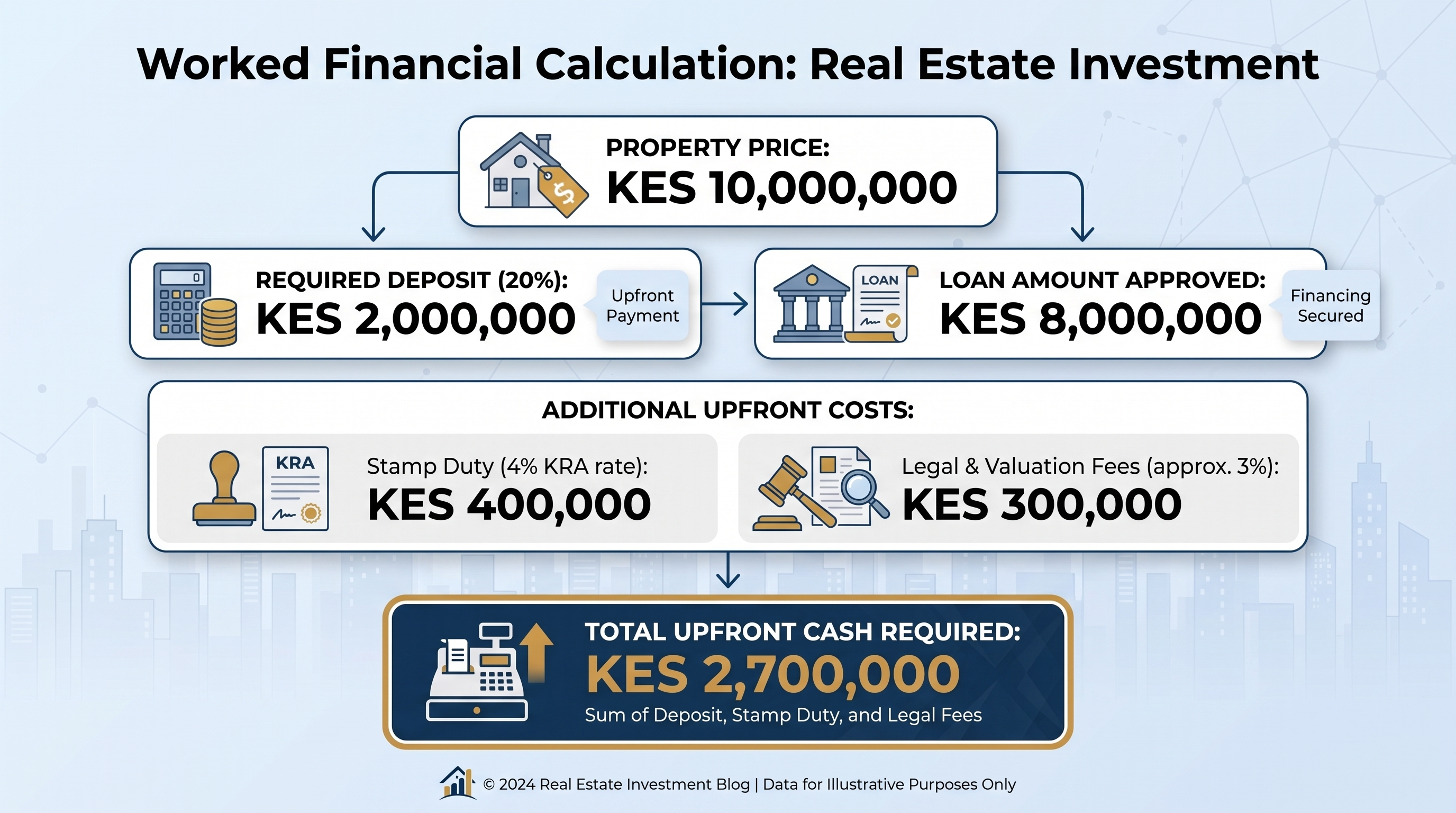
Before you browse all properties, it is crucial to understand the total capital required. Lenders rarely finance 100% of the property value. You must prepare for the initial deposit, stamp duty, and associated legal fees.
According to the Kenya Revenue Authority (KRA), stamp duty is charged at 4% for urban areas like Nairobi and 2% for rural areas. Rehani Soko data shows that understanding the yield potential of different neighborhoods can help you justify these upfront costs to your lender.
Worked Financial Calculation:
3. Navigating the Approval Timeline
Securing a mortgage is not an overnight event. Market data consistently shows that buyers who pre-organize their finances experience significantly faster approval times. The timeline involves several distinct phases, from pre-approval to the final disbursement of funds to the seller.
Key Statistical Targets for Loan Approval
📊Debt-to-Income Ratio
Target ThresholdBelow 35%
Impact on Approval OddsHigh
📊Deposit/Down Payment
Target Threshold10% to 20% minimum
Impact on Approval OddsHigh
📊Credit Score (CRB)
Target ThresholdNo negative listings
Impact on Approval OddsCritical
📊Employment History
Target Threshold2+ years consistent
Impact on Approval OddsMedium
Delays often occur at the lands registry or during the valuation phase. By anticipating these steps, you can manage your expectations and ensure your funds are ready when needed.
4. Preparing Your Documentation
The most common hurdle in securing housing finance is incomplete paperwork. Transaction patterns confirm that missing or unverified documents cause the majority of loan application rejections. Lenders need absolute certainty about your identity, your income, and the legality of the property you intend to buy.
Working with registered professionals is non-negotiable. Ensure your structural assessments meet the Architectural Association of Kenya (AAK) standards and that the property has a clean title deed.
Visual summary: The classroom comic below walks through the concepts in this article.
📖
Hani Explains It
Page 1 of 2
Actionable Next Steps
Ready to take the next step toward owning your home in Kenya? Use these resources to streamline your journey:
Have legal or financial questions? Consult Ask Hani for instant guidance.
Financial Calculation Example:
If purchasing a home for KES 10,000,000 with a 20% deposit (KES 2,000,000), your loan amount is KES 8,000,000. According to Central Bank of Kenya (CBK) data, assuming an average interest rate of 13% over a 15-year term, your estimated monthly repayment is approximately KES 101,219.
Pros and Cons of Financing Options
✨
Commercial Bank Mortgage
Longer repayment periods (up to 25 years)
DisadvantagesStricter CRB and income requirements
✨
SACCO Loans
Dividends earned on deposits; flexible terms
DisadvantagesShorter repayment periods (typically 3-7 years)
✨
Developer Payment Plans
Zero interest; easier qualification
DisadvantagesRequires high initial deposits and fast payments
5 Key Takeaways:
Consistent income documentation is prioritized over large, unexplained deposits.
Diaspora investors must align their foreign income with local banking requirements.
Getting pre-approved sets realistic boundaries for your property search.
Transaction patterns confirm that complete paperwork reduces approval times significantly.
A strong credit history in your country of residence supports your Kenyan application.
Important Disclaimer: This content is for informational purposes only and does not constitute formal financial, legal, or tax advice. Always consult with certified professionals before committing to a mortgage agreement.
When navigating housing finance in Kenya, commercial banks and SACCOs evaluate several critical factors before approving a mortgage application. According to Rehani Soko market intelligence, the primary factor is your debt-to-income ratio. Lenders want to ensure that your total monthly debt repayments, including the new mortgage, do not exceed fifty percent of your net income. Additionally, a consistent employment history or stable business revenue is crucial, as it demonstrates your ability to maintain long-term payments. Lenders also scrutinize your credit history through the Credit Reference Bureau (CRB). A clean CRB report is mandatory. Finally, the property itself plays a role; lenders require a professional valuation to confirm the asset's worth matches the loan amount. Preparing these elements in advance ensures a smoother process, allowing you to confidently secure financing for your dream home in Nairobi or its surrounding areas.