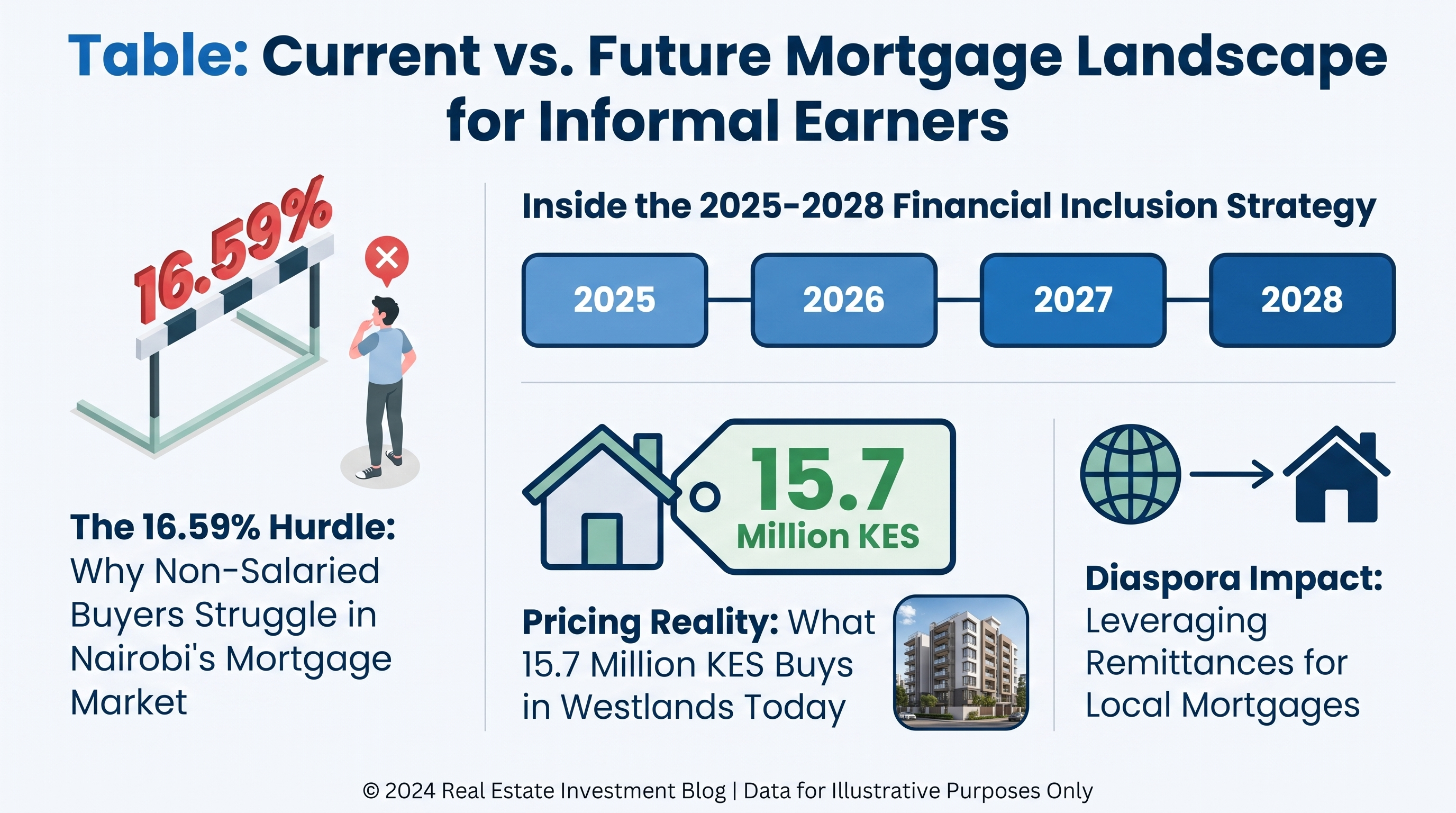
The 16.59% Hurdle: Why Non-Salaried Buyers Struggle in Nairobi's Mortgage Market
For years, buying a home in Kenya has felt like an exclusive club reserved for those with a standard payslip. If you are an entrepreneur in Gikomba, a freelance consultant in Kilimani, or a diaspora investor running a business abroad and longing for a permanent connection to home, the traditional banking system often views your income with suspicion.
Rates on the Rehani network · Kenya
Live Rehani network quotes for a Kenya apartment in KES.
According to the Central Bank of Kenya (CBK), average commercial lending rates have hovered around 16.59%, presenting a steep barrier for prospective buyers. However, the interest rate is only half the battle. The primary obstacle for non-salaried buyers is income verification. Financial institutions require consistent, predictable cash flows, which penalizes the informal sector and self-employed individuals whose incomes naturally fluctuate. Rehani Soko market data consistently shows that non-salaried applicants face higher rejection rates than their formally employed counterparts, even when their annual earnings are identical.
This financing gap leaves many capable buyers locked out of the market. Fortunately, the government's 2025-2028 Financial Inclusion Strategy aims to address this exact friction. By introducing alternative credit scoring models and recognizing non-traditional income streams, the strategy offers renewed hope for millions. For diaspora buyers wanting to secure properties in Nairobi, a clear process removes the uncertainty that usually accompanies cross-border investments.
Visual summary: The comic series below walks through the story and ideas in this article.
📖
Nairobi Returns: The Paper Trail
Page 1 of 5
As the financial landscape shifts to accommodate the informal sector, understanding your borrowing capacity becomes critical. Transaction patterns confirm that prepared buyers secure better terms. You can evaluate your current standing and explore financing options using our mortgage calculator to see how the impending market changes might finally work in your favor.
Inside the 2025-2028 Financial Inclusion Strategy
The Central Bank of Kenya (CBK) recently outlined the 2025-2028 Financial Inclusion Strategy, a policy framework designed to bring the informal sector into the formal credit system. Market data consistently shows that while non-salaried workers drive a massive portion of Kenya's economy, they remain largely locked out of long-term housing finance. This new strategy targets that exact gap, pushing financial institutions to rethink how they assess creditworthiness.
Feature
1
Income Verification
Current Traditional ModelRequires formal corporate payslips
→
2025-2028 Strategy GoalsAccepts digital business records
2
Credit Scoring
Current Traditional ModelRelies on formal credit history
→
2025-2028 Strategy GoalsIncludes alternative data points
3
Diaspora Assessment
Current Traditional ModelOften requires local employment
For the Kenyan diaspora, this shift is highly relevant. Securing a property back home is a deeply held aspiration, and many expatriates co-invest with family members who run local businesses. A clear process removes the uncertainty of securing joint financing when one applicant lacks a traditional payslip.
According to the Central Bank of Kenya (CBK), integrating alternative credit scoring models allows lenders to evaluate risk based on actual cash flow and mobile money transactions rather than relying solely on formal employment records. This means business owners in commercial hubs like Eastleigh or River Road can finally have their true financial capacity recognized by mortgage lenders.
Rehani Soko market intelligence indicates that as commercial banks adopt these new frameworks, mortgage approval rates for entrepreneurs will improve. Lenders are already testing pilot programs that align with the CBK's directives. If you want to see how current lending criteria apply to your specific income structure, you can get a mortgage quote tailored to your profile. By bridging the gap between informal income and formal credit, the 2025-2028 strategy sets a foundation for broader homeownership across Nairobi and beyond.
Pricing Reality: What 15.7 Million KES Buys in Westlands Today
According to Rehani Soko property analytics, 15.7 million KES currently secures a premium, modern two-bedroom apartment in the heart of Westlands. For diaspora investors longing to establish a firm footprint back home, and local business owners operating in the informal sector, understanding this specific price point is crucial. Market data consistently shows that properties in this commercial node maintain high occupancy rates due to proximity to international headquarters and retail centers.
Historically, acquiring a prime asset in Westlands was a privilege reserved for traditional corporate employees with standard payslips. However, the 2025-2028 Financial Inclusion Strategy is designed to open these doors for self-employed Kenyans. As you explore properties in Nairobi, having a clear process removes the uncertainty surrounding total closing costs. Knowing exactly what you need to save empowers you to make confident decisions.
According to the Kenya Revenue Authority (KRA), standard stamp duty applies for urban jurisdictions like Westlands. For a successful informal sector entrepreneur finally qualifying for a home loan under the new strategy, these additional closing costs must be prepared upfront.
The transition from renting to owning in a high-value area marks a significant milestone for any family. Transaction patterns confirm that prepared buyers close deals faster and negotiate better terms. You can input these exact figures into the Rehani Soko mortgage calculator to structure your deposit and monthly repayments. Securing a tangible asset in your homeland brings a deep sense of pride, and these new financial policies ensure that your hard-earned business revenue can finally translate into prime real estate ownership.
Diaspora Impact: Leveraging Remittances for Local Mortgages
For Kenyans living abroad, building a foundation at home brings a deep sense of pride and belonging. Historically, securing property financing from overseas meant navigating complex income verification processes, particularly for those whose foreign earnings did not fit traditional local banking profiles. The 2025-2028 Financial Inclusion Strategy addresses this disconnect, making it easier to translate overseas income into local homeownership.
Applicant Profile
1
Formal Salaried
Standard Processing
Primary Rejection ReasonHigh Debt-to-Income Ratio
2
SME Business Owners
Extended Processing
Primary Rejection ReasonInconsistent Bank Deposits
3
Diaspora/Freelance
Extended Processing
Primary Rejection ReasonUnverifiable Foreign Income
According to the Central Bank of Kenya (CBK), diaspora remittances consistently rank as the country's leading source of foreign exchange. Despite this, turning these regular inflows into formal mortgage approvals used to be a frustrating experience. The new financial strategy encourages local lenders to recognize consistent remittance patterns as verifiable proof of income. A clear process removes the uncertainty that previously discouraged overseas buyers.
Rehani Soko market data shows an increase in diaspora inquiries for properties in Nairobi over the last twelve months. Banks are now structuring specialized products that accept international remittance slips and foreign bank statements. Market data consistently shows that when financial institutions adapt to these income streams, diaspora investment in real estate grows significantly.
To understand how these evolving policies affect your purchasing power, you can use our mortgage calculator to estimate potential monthly repayments based on your current remittance capacity.
When planning a property purchase from abroad, preparing for the associated closing costs is essential. Below is a breakdown of typical closing expenses for an overseas buyer acquiring a 10 million KES home.
For overseas buyers needing guidance on remote legal representation or setting up a power of attorney, Ask Hani provides immediate answers on navigating the Kenyan legal framework from afar. This inclusive strategy finally gives the diaspora a reliable path to investing in their homeland.
Preparing Your Finances: Steps for Informal Earners to Qualify
For many business owners and gig workers, a clear process removes the uncertainty of applying for a home loan. The 2025-2028 Financial Inclusion Strategy shifts the lending focus away from traditional payslips, emphasizing consistent cash flow instead. However, you must still prove your repayment ability.
According to Rehani Soko market intelligence, lenders now prioritize 6 to 12 months of structured banking or mobile money statements over standard employment contracts. Furthermore, according to the Kenya Revenue Authority (KRA), maintaining an updated tax compliance certificate has become a strict baseline requirement for non-salaried mortgage applicants in Nairobi and beyond.
To position yourself for approval, you need a structured approach to your daily finances.
For Kenyans in the diaspora sending funds home to support family enterprises, ensuring these remittances are formally documented helps build a stronger financial profile for local applicants. Building a home in Kenya remains a deeply rooted aspiration, and structuring your informal income correctly brings that vision to life, allowing you to invest proudly in your homeland.
If you are unsure how your current business income translates into borrowing power, you can evaluate your capacity using our mortgage calculator. Lenders want to see predictability. By organizing your daily deposits and strictly separating your business costs from household spending, you present a reliable profile that aligns with the new inclusion standards. For specific questions regarding acceptable informal income documentation or KRA compliance, you can direct your queries to our AI assistant, Ask Hani. Taking these steps early ensures you are ready when the right property appears.
Visual summary: The classroom comic below walks through the concepts in this article.
📖
Hani Explains It
Page 1 of 2
5 Key Takeaways
The new national strategy encourages lenders to accept alternative credit scoring for informal and business incomes.
Consistent banking history now carries similar weight to traditional corporate employment letters.
According to the Central Bank of Kenya (CBK) guidelines, diaspora remittances are increasingly recognized as verifiable income.
Transaction patterns confirm that organized financial records reduce loan processing delays significantly.
Rehani Soko provides tailored financing pathways specifically for non-salaried and diaspora buyers.
Have legal or financing questions? Ask our AI assistant at Ask Hani.
Disclaimer: This article is for informational purposes only. Mortgage rates and eligibility criteria are subject to change based on individual financial profiles and CBK regulations. Always consult a certified financial advisor before making major investment decisions.
The 2025-2028 Financial Inclusion Strategy fundamentally alters how lenders assess creditworthiness for Kenyans operating outside formal employment. Historically, commercial banks required standard payslips, leaving business owners, gig workers, and diaspora members with irregular remittance flows locked out of homeownership. Under the new framework championed by the Central Bank of Kenya (CBK), financial institutions are now mandated to accept alternative data points. This includes mobile money transaction histories, digital savings records, and consistent supplier payments as valid proof of income. For prospective buyers looking at [properties in Nairobi](https://www.rehanisoko.com/houses-for-sale-in-nairobi), this means your daily business cash flow is finally recognized. By standardizing these alternative credit scoring models, the strategy ensures that a clear process removes the uncertainty that previously discouraged informal workers from applying. It bridges the gap between everyday Kenyan enterprise and formal homeownership, making property acquisition more accessible.