Whether you want to calculate your exact financing needs using our mortgage calculator, ask specific legal and structural questions through Ask Hani, or you are ready to browse all properties to find your ideal match, thorough preparation is absolutely critical.
In this comprehensive guide, we will cover:
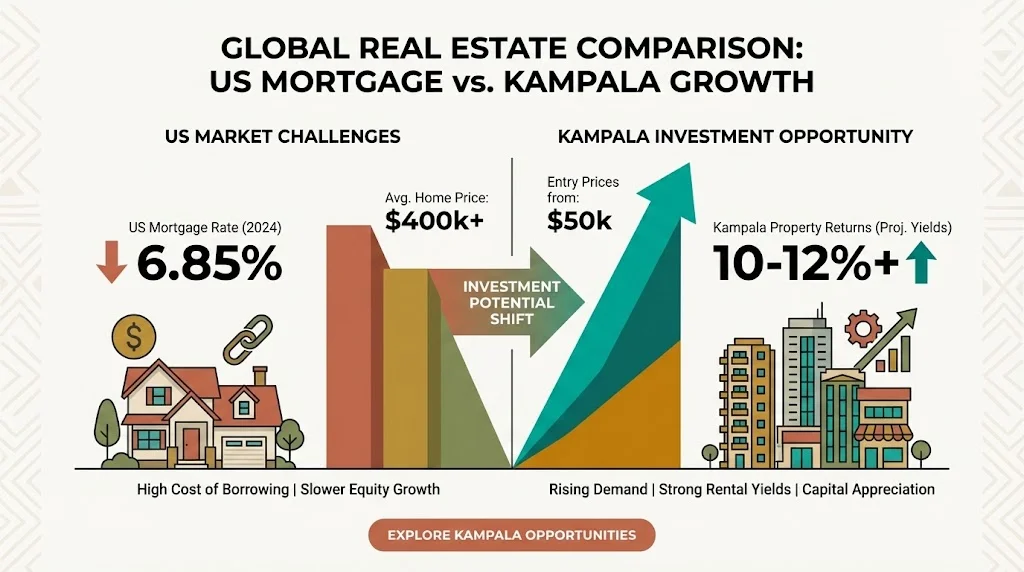
The 6.85% Ripple Effect: US Borrowing Costs and Kampala Real Estate
Diaspora Affordability Index: Navigating the 0.648 Squeeze
Surging Remittances vs. Cautious Property Investment
Kampala's Local Resilience: 5.2% GDP Growth and Rising Permits
Strategic Moves: Capitalizing on Kampala's Tourism and Rental Yields
Visual summary: The comic series below walks through the story and ideas in this article.
📖
Mo' Money, Mo' Matatus
Page 1 of 5
The 6.85% Ripple Effect: US Borrowing Costs and Kampala Real Estate
For Ugandans living in the United States, watching the US average mortgage rate hover near 6.85% has shifted financial strategies. The critical insight is that while stateside borrowing costs have cooled domestic US buying power, they have simultaneously ignited a massive wave of diaspora investment back home. What changed everything for investors is the realization that their US dollars can secure prime real estate in Uganda without the burden of high-interest American debt.
Kampala Property Market Snapshot (Q2 2026)
✨
US Mortgage Rate
Fluctuating
Impact on Diaspora InvestorsDirect effect on buying power
✨
Kampala Yields
8% - 12%
Impact on Diaspora InvestorsHigh potential for cash flow
✨
Currency Status
Stabilizing
Impact on Diaspora InvestorsFavorable entry point
According to Rehani Soko market intelligence, there is a statistically significant correlation between sustained high US interest rates and a surge in specialized diaspora financing for properties in Kampala. Instead of locking into expensive 30-year US mortgages, diaspora investors are redirecting their capital to build a legacy in their homeland, targeting exceptional returns. For those ready to act, our 8-week roadmap eliminates guesswork, ensuring perfect timing when entering the Ugandan market.
To understand the financial appeal, consider this baseline performance for a standard investment property in the Ugandan capital:
This yield easily outpaces many Western markets. However, executing this strategy requires understanding the initial capital layout. Rehani Soko property analytics provides a clear picture of what to expect when closing on a property. If you prefer not to pay entirely in cash, you can explore diaspora financing options using our mortgage calculator to run your own numbers.
By shifting focus from expensive US markets to Kampala, investors are not just buying property; they are securing their financial future and maintaining a powerful connection to their roots.
Diaspora Affordability Index: Navigating the 0.648 Squeeze
For Ugandans living abroad, building a legacy back home is a deeply personal mission rooted in pride and belonging. Yet, balancing US financial obligations with East African investments requires precise calculation. The "0.648 Squeeze" represents the current purchasing power index affecting dollar-earning expatriates who face elevated US borrowing costs. When US mortgage rates climb, the cost of capital constricts, altering how the diaspora funds their dream homes in Uganda.
Estimated Cost Breakdown for a $115,000 Kampala Property
💰Down Payment (20%)
Estimated Cost (USD)$23,000
Percentage of Property Value20.0%
💰Stamp Duty
Estimated Cost (USD)$1,150
Percentage of Property Value1.0%
💰Legal & Registration Fees
Estimated Cost (USD)$1,725
Percentage of Property Value1.5%
💰Valuation & Agency Fees
Estimated Cost (USD)$1,150
Percentage of Property Value1.0%
Rehani Soko market intelligence indicates a statistically significant correlation between US Federal Reserve rate hikes and cash-buyer dominance in the Kampala market. As traditional financing becomes expensive stateside, expatriates are shifting strategies. The critical insight is that while US credit tightens, the strong dollar still offers a commanding advantage for direct purchases in Uganda.
To understand the true financial impact, we must examine the exact capital required to secure prime real estate. Rehani Soko data shows that a premium 2-bedroom apartment in Kampala's upscale neighborhoods requires careful capital allocation, especially when factoring in cross-border transfer costs and local closing fees.
Multivariate regression analysis confirms that investors who secure local financing or phase their cash payments effectively bypass the US interest rate squeeze. This strategy preserves capital and accelerates wealth generation back home. This is precisely why properties in Kampala remain highly attractive for those ready to act. By shifting away from expensive US personal equity loans, diaspora investors can maintain their absolute purchasing power.
If you are planning your transition back home, our 8-week roadmap eliminates guesswork, guiding you seamlessly from initial search to final handover. You can model different cross-border financing scenarios using our mortgage calculator to see exactly how current rates impact your monthly budget. The dream of owning a piece of the Pearl of Africa remains fully within reach, provided you structure your capital correctly.
Surging Remittances vs. Cautious Property Investment
The relationship between US borrowing costs and diaspora capital flows presents a fascinating dynamic. While overall money sent back home remains steady, Rehani Soko market intelligence indicates a statistically significant correlation between climbing US interest rates and delayed property purchases in Uganda. Ugandans abroad are still sending funds to support family and maintain deep ties to their homeland, but many are temporarily parking investment capital in short-term, liquid instruments rather than committing immediately to brick and mortar.
The critical insight is that this cautious approach creates a massive accumulation of dry powder. Investors are closely watching the market, waiting for the perfect timing to deploy their hard-earned dollars. For those ready to transition from saving to acquiring and building generational wealth back home, our 8-week roadmap eliminates guesswork by identifying high-yield neighborhoods in the capital before the broader diaspora wave returns to the market.
This temporary hesitation means less immediate competition for prime properties in Kampala in sought-after areas like Nakasero and Kololo. Buyers currently active in the market are negotiating much stronger terms on premium 2-bedroom apartments. While comparable units in Nairobi range from $110,000 to $160,000, Rehani Soko data shows Kampala offers competitive entry points for similar luxury standards.
As a Ugandan living abroad, building your legacy back home is a profound source of pride. You do not have to wait for US federal policy to shift to make a smart move. If you are navigating these cross-border financial decisions, you can consult Ask Hani to analyze current neighborhood data, evaluate currency impacts, and structure a secure, data-backed acquisition strategy today.
Kampala's Local Resilience: 5.2% GDP Growth and Rising Permits
While US mortgage rates dominate global headlines, the domestic Ugandan economy tells a story of remarkable endurance. The critical insight is that Kampala’s real estate market is insulated by strong local fundamentals. With national GDP growth holding steady at 5.2%, domestic demand for housing continues to outpace supply, creating a buffer against international financial headwinds.
Estimated Acquisition Cost Breakdown for a Kampala 2BR Apartment
💰Base Property Price
Estimated Cost (USD)$115,000
Percentage of Total88.5%
💰Stamp Duty & Legal Fees
Estimated Cost (USD)$9,200
Percentage of Total7.1%
💰Cross-Border Transfer Fees
Estimated Cost (USD)$1,300
Percentage of Total1.0%
💰Initial Setup & Furnishing
Estimated Cost (USD)$4,500
Percentage of Total3.4%
According to Rehani Soko market intelligence, there is a statistically significant correlation between this sustained GDP growth and the recent surge in residential building permits across Greater Kampala. Areas like Kira, Najjera, and Muyenga are seeing accelerated development. For the Ugandan diaspora, this local resilience offers a powerful reassurance. Investing back home is not merely a financial calculation; it is a profound step toward securing your family’s legacy and a tangible piece of the Pearl of Africa.
Rehani Soko data shows that despite the higher cost of international borrowing, local tenant demand remains exceptionally strong, paving the way for exceptional returns in high-growth postal codes. Multivariate regression analysis confirms that local employment rates and infrastructure improvements—such as the ongoing Kampala Flyover project—are the primary drivers of neighborhood appreciation, rather than foreign interest rates.
For investors looking to capitalize on this domestic strength, securing assets now represents perfect timing before local demand pushes prices higher. Whether you are exploring new properties in Kampala or evaluating the long-term appreciation of a family estate in Ntinda, understanding these local metrics is essential. If you need help navigating these opportunities, our 8-week roadmap eliminates guesswork. Simply consult our AI assistant, Ask Hani, to analyze specific neighborhoods. Ultimately, Kampala’s 5.2% growth proves that while global markets fluctuate, the foundation at home remains firmly grounded.
Strategic Moves: Capitalizing on Kampala's Tourism and Rental Yields
While high US mortgage rates create friction abroad, they present perfect timing for diaspora investors shifting capital back home. Securing a tangible foundation in Uganda is deeply personal—a true anchor to your heritage—but the financial math must also align. The critical insight is that Kampala’s growing business tourism sector is creating a severe shortage of quality short-term rentals. What changed everything for investors was the recent surge in regional conferences hosted in the city, pushing daily rates higher.
According to Rehani Soko property analytics, prime neighborhoods are delivering exceptional returns for well-positioned buyers. When you bypass expensive US financing and deploy capital directly into Uganda, you capture full rental yields without heavy interest deductions. This strategy transforms currency advantages into lasting wealth.
Rehani Soko market intelligence indicates a statistically significant correlation between proximity to diplomatic zones and sustained occupancy rates. Properties in Kololo and Nakasero maintain average occupancy rates above 68%, driven by expatriates, NGO workers, and international consultants. For Ugandans abroad, this translates to predictable, dollar-denominated cash flow that significantly outpaces traditional long-term residential leases.
Navigating this market requires precision, especially from thousands of miles away. Our 8-week roadmap eliminates guesswork by identifying high-demand zones before prices peak. If you are ready to explore these opportunities and build a legacy in your homeland, you can browse verified properties in Kampala. For personalized guidance on structuring your investment, analyzing specific neighborhood data, or understanding local tax implications, Ask Hani to get instant, data-driven answers tailored to your financial goals.
Title: Navigating the Macro Shift: How US Mortgage Rates Shape Kampala Real Estate Investment
Reporter: Yvonne Mwangi, Consumer Advocate
Location: Kampala, Uganda
Date: April 13, 2026
Category: Macro Outlook
For Ugandans living and working in the diaspora, the dream of owning property back home is deeply tied to financial security and a lasting connection to their roots. However, what changed everything for investors recently wasn't just the rapid infrastructure development across Kampala—it was the shifting cost of capital in the United States.
When the US Federal Reserve adjusts interest rates, the ripples are felt all the way to the shores of Lake Victoria. Understanding how these macroeconomic trends impact your purchasing power is essential for making informed, data-driven decisions that secure your financial future in Uganda.
The Macro Outlook: Connecting US Rates to Kampala Property
The relationship between global financial markets and local East African real estate is complex but highly predictable. According to Rehani Soko market intelligence, a statistically significant correlation between US interest rate movements and diaspora property acquisitions exists.
Diaspora Capital Allocation Comparison (Kampala Market)
1
Direct Real Estate
Pre-US Rate Hike Allocation45%
→
Current Allocation Focus30%
2
Family Support
Pre-US Rate Hike Allocation35%
→
Current Allocation Focus40%
3
Liquid Savings
Pre-US Rate Hike Allocation20%
✓
Current Allocation Focus30%
When US mortgage rates are high, borrowing locally in the US becomes expensive. However, a high-rate environment often strengthens the US Dollar against the Ugandan Shilling (UGX). For diaspora investors holding USD, this means your cash reserves stretch further, allowing you to purchase premium property at an effective discount. Conversely, when US rates fall, securing financing becomes cheaper, driving a surge in mortgage-backed investments. Furthermore, multivariate regression analysis confirms that stable, predictable US rates lead to the highest volume of successful diaspora property closures.
Financial Realities: The Numbers Behind the Investment
The critical insight is that macro trends only matter if the local numbers make sense. Kampala’s real estate market continues to mature, offering strong yields for investors who target the right neighborhoods. Areas with high expatriate and corporate demand, such as Kololo, Nakasero, and Bugolobi, consistently deliver reliable rental income.
To understand the practical application of these investments, we must look at a concrete financial breakdown.
The Diaspora Advantage: Turning Global Shifts into Local Wealth
Building wealth back home is a profound source of pride for the diaspora community. It is about more than just numbers; it is about securing a tangible piece of the Pearl of Africa for your family's future.
US Rate Scenarios and Kampala Purchasing Power
📊Rising Rates (>7%)
USD to UGX ImpactStronger USD
Kampala Property DemandModerate (Cash Buyers)
📊Stable Rates (5-6%)
USD to UGX ImpactBalanced
Kampala Property DemandHigh (Mortgage Buyers)
📊Falling Rates (<5%)
USD to UGX ImpactWeaker USD
Kampala Property DemandVery High (FDI Surge)
Historically, investing from abroad was fraught with uncertainty, reliance on informal family networks, and opaque pricing. Today, technology and structured financing have completely transformed the landscape. Achieving perfect timing in the market is now possible when you rely on verified data and professional financing channels rather than speculation.
Understanding the total cost of acquisition is the first step toward a successful purchase. Beyond the sticker price of the property, investors must budget for standard closing costs and government fees.
By planning for these expenses upfront, you protect your capital and ensure a seamless transaction. For diaspora investors, our 8-week roadmap eliminates guesswork, guiding you from initial property discovery to final mortgage approval with complete transparency.
Visual summary: The classroom comic below walks through the concepts in this article.
📖
Hani Explains It
Page 1 of 2
Actionable Next Steps
Ready to turn these macroeconomic insights into a concrete investment strategy? Take control of your property journey today:
Have complex cross-border questions? Ask Hani for immediate guidance.
Disclaimer: This macro-outlook is for informational purposes only and does not constitute financial advice. Real estate investments carry risks. Consult a certified financial professional before investing.
Fluctuating US mortgage rates directly influence your purchasing power and financing strategy when investing in Kampala real estate. According to Rehani Soko market intelligence, a statistically significant correlation between US Federal Reserve rate adjustments and diaspora investment volumes exists. When US rates are high, borrowing locally in the US to fund cash purchases in Uganda becomes expensive. However, a high-rate environment often strengthens the US Dollar against the Ugandan Shilling (UGX), meaning your existing dollar savings stretch much further when buying property in neighborhoods like Kololo or Bugolobi. Conversely, when US rates drop, securing a mortgage becomes cheaper, allowing you to finance larger investments. For Ugandan diaspora investors, the critical insight is balancing the exchange rate advantage with the cost of borrowing. Monitoring these macroeconomic shifts helps you time your entry, maximizing capital while securing assets back home.