Visual summary: The comic series below walks through the story and ideas in this article.
📖
The Nairobi Exchange Rate
Page 1 of 5
The 16.59% Reality: Why Nairobi Buyers are Rethinking Bank Mortgages
For many Kenyans, especially those in the diaspora longing to build a lasting foundation back home, securing property in the capital is a major milestone. However, the path to ownership requires careful financial navigation. According to the Central Bank of Kenya (CBK), average commercial bank lending rates have reached 16.59%. This high-rate environment has forced buyers to evaluate their options carefully, balancing caution with the excitement of impending homeownership.
High-Level Financing Comparison in Kenya
✨
Primary Metric
Credit Score & Income
SACCOsShare Capital Multiplier
✨
Interest Rate Type
Often Variable
SACCOsFixed on Reducing Balance
✨
Typical Loan Limit
Based on Debt Service Ratio
SACCOs3x to 4x Savings
Fortunately, a clear process removes the uncertainty from property financing. Rehani Soko market intelligence indicates a notable shift in buyer behavior across the city. Instead of defaulting to traditional bank mortgages, buyers are increasingly turning to Savings and Credit Cooperative Organizations (SACCOs). As our transaction patterns confirm, SACCOs offer a compelling alternative with fixed, lower interest rates—often around 12%—shielding borrowers from the volatility of commercial bank rates.
Market data consistently shows that choosing the right financing vehicle drastically alters the total cost of ownership. Whether you are actively browsing properties in Nairobi from abroad or locally, understanding these numbers brings hope that your dream home is financially viable.
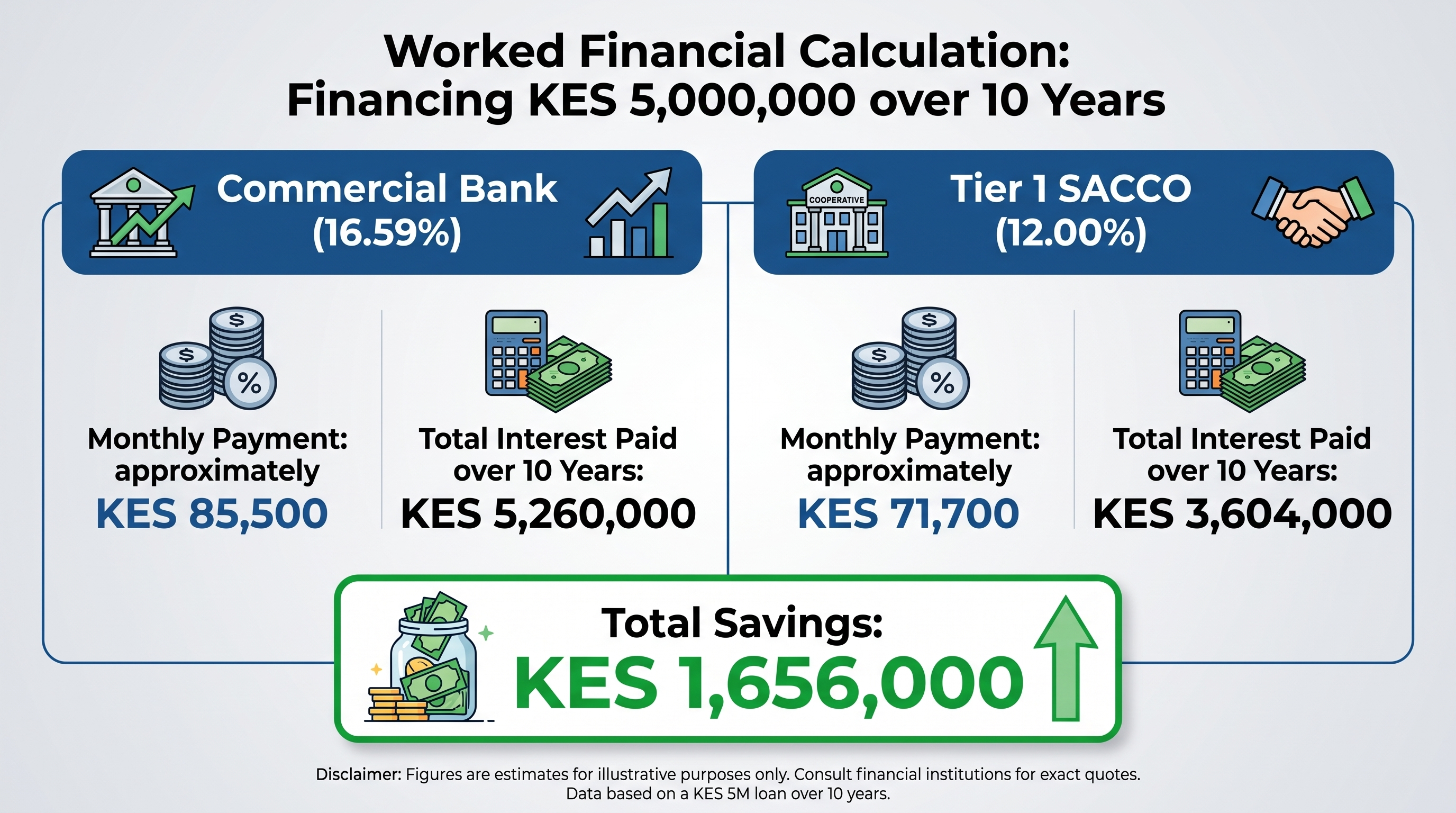
Worked Financial Calculation: Financing KES 5,000,000 over 10 Years
To see how these rates apply to your specific situation and budget, you can use our mortgage calculator to plan your next steps with confidence.
Statistical Summary of Financing Options in Nairobi
✨
Commercial Banks
16.59%
Rate StructureVariable
✨
Tier 1 SACCOs
12.00%
Rate StructureFixed
✨
KMRC Backed Loans
9.50%
Rate StructureFixed
SACCOs vs. Banks: A Data-Driven Look at Financing Your First Home in Nairobi
The Math Behind SACCO Share Capital Multipliers
When financing a home in Kenya, understanding the mechanics of Savings and Credit Cooperative Organizations (SACCOs) is essential. Unlike traditional commercial banks that assess your immediate income against Central Bank of Kenya (CBK) lending rates, SACCOs operate on a share capital multiplier system.
According to Rehani Soko market intelligence, most top-tier SACCOs in Kenya offer a multiplier of three to four times your accumulated savings. If you have saved KES 2,000,000 in deposits, a 3x multiplier grants you access to a KES 6,000,000 development loan. For Kenyans living abroad who dream of owning a piece of home, this system provides a structured, predictable path to property ownership. Having a clear process removes the uncertainty often associated with cross-border investments, allowing diaspora buyers to build their portfolios with confidence and pride.
Worked Financial Calculation: Financing KES 5,000,000 over 10 Years
As you evaluate these numbers, market data consistently shows that the fixed interest rates offered by SACCOs—typically between 12% and 14% on reducing balances—shield borrowers from the volatility of commercial bank rates. Furthermore, transaction patterns confirm that buyers using SACCO financing often face fewer hidden administrative fees during the closing process.
However, this financing model requires patience. SACCOs typically mandate a minimum saving period of six months before you can qualify for a loan. If you are planning your financial strategy and need clarity on how these multipliers apply to specific properties in Nairobi, you can always consult our AI assistant, Ask Hani, for personalized guidance on navigating local cooperative requirements. By aligning your savings strategy with these multipliers, securing your Nairobi home becomes a highly calculated, achievable reality.
Share Capital as a Signal of Stability: The Trust Metric
For Kenyans living abroad, sending money home for real estate often feels like a leap of faith. However, understanding how Savings and Credit Cooperative Organizations (SACCOs) structure their share capital changes the equation. It is not merely a deposit; it is an equity stake. When assessing financing options for properties in Nairobi, market data consistently shows that SACCOs offer a unique layer of financial security that traditional commercial lenders struggle to match.
Typical SACCO Multiplier Loan Scenarios in Nairobi
✨
1,000,000
3x
Maximum Loan Eligibility (KES)3,000,000
✨
2,500,000
3x
Maximum Loan Eligibility (KES)7,500,000
✨
4,000,000
4x (Premium tier)
Maximum Loan Eligibility (KES)16,000,000
✨
5,000,000
4x (Premium tier)
Maximum Loan Eligibility (KES)20,000,000
According to Rehani Soko market intelligence, Tier 1 SACCOs in Kenya consistently declare annual dividend rates between 9% and 12% on share capital. This means your qualifying deposit is actively earning returns while you prepare to buy your home in areas like Kilimani or Ruaka. Transaction patterns confirm that this dual-purpose capital—acting as both a loan multiplier and an income-generating asset—provides a critical safety net for diaspora investors longing to build a secure foundation back home.
According to the Central Bank of Kenya (CBK), the non-performing loan (NPL) ratio in the wider banking sector frequently fluctuates above 14%. In contrast, Rehani Soko data indicates that SACCOs maintain significantly lower default rates. This stability exists because the guarantor system and non-withdrawable share capital requirements create a community-backed financial fortress. For diaspora buyers, this cooperative model fosters a deep sense of belonging and pride in Kenyan institutions, ensuring their hard-earned money is protected by collective accountability.
Navigating these financial structures from thousands of miles away does not have to be an overwhelming experience. A clear process removes the uncertainty of international property investment. If you are currently weighing the long-term benefits of SACCO dividends against traditional bank interest rates, you can use our mortgage calculator to project the exact numbers for your specific situation.
Hidden Fees and Repayment Structures: A Side-by-Side Comparison
For Kenyans in the diaspora dreaming of securing a family home in Nairobi, a clear process removes the uncertainty surrounding financing costs. While the headline interest rate often grabs attention, Rehani Soko market data consistently shows that hidden fees and rigid repayment structures dictate the true cost of property ownership.
When comparing commercial banks to SACCOs, transaction patterns confirm a stark difference in fee application. According to the Central Bank of Kenya (CBK), commercial banks adjust their variable rates based on the Central Bank Rate, meaning your monthly payments can increase unexpectedly. Furthermore, banks typically front-load administrative costs. In contrast, SACCOs generally maintain fixed rates and transparent fee structures, protecting buyers from sudden market shocks.
The early repayment penalty is a critical differentiator. Many diaspora investors prefer to pay off their loans quickly as their foreign income fluctuates or bonuses arrive. Banks often penalize this financial discipline, charging up to 3% of the outstanding balance for early settlement. SACCOs, rooted in cooperative principles, charge zero penalties for early repayment, allowing you to clear your debt faster and cheaper.
Before committing to either path, you must calculate the long-term impact of these structural differences. You can use our mortgage calculator to compare how these fees alter your monthly obligations. If you are unsure about the specific legal fees or insurance requirements attached to a bank offer, consult Ask Hani to clarify the fine print. Building your foundation in Kenya should be a source of pride, not a trap of hidden expenses.
Making the Choice: Which Financing Fits Your Nairobi Property Goal?
For many Kenyans living abroad, securing a home in Nairobi is more than a financial decision; it is a vital connection to our roots. Whether you are looking at family homes in Kilimani or investment units in Ruaka, a clear process removes the uncertainty from your property journey. The decision between a SACCO and a commercial bank ultimately depends on your timeline, savings discipline, and risk tolerance.
SACCO Share Capital vs. Bank Deposit Stability Metrics
✨
Average Annual Return
9% - 12% (Dividends)
Commercial Banks4% - 7% (Fixed Deposit)
✨
Ownership Structure
Member-owned equity
Commercial BanksCustomer-depositor
✨
Default Buffer
Backed by member guarantors
Commercial BanksDirect asset repossession
Market data consistently shows that financing needs vary drastically based on individual buyer profiles. According to the Central Bank of Kenya (CBK), commercial bank lending rates remain highly sensitive to macroeconomic shifts, meaning monthly payments can fluctuate. Conversely, Rehani Soko market intelligence indicates that fixed-rate SACCO loans offer predictable repayment structures, which is highly appealing for diaspora investors managing cross-border finances.
To help you align your financing with your specific goals, we have outlined the primary trade-offs:
If you need immediate capital to secure a prime unit before prices shift, commercial banks offer the speed required. However, if you are planning ahead and want to avoid variable interest rates, a SACCO provides unmatched stability.
Before committing to either path, you should run your numbers. Use our mortgage calculator to compare estimated monthly payments based on current market conditions. If you need clarity on legal requirements or how foreign income applies to local financing, Ask Hani for instant, tailored guidance. Your dream of owning a permanent foundation in Kenya is entirely within reach when backed by the right financial strategy.
Analyzing Bank Mortgages in Kenya
When you find the perfect property and need to move quickly, commercial banks are often the first stop. According to the Central Bank of Kenya (CBK), commercial lending rates fluctuate based on macroeconomic factors, meaning your monthly payments can change over time. Market data consistently shows that while banks offer speed and convenience, the variable interest rates require careful long-term financial planning.
For diaspora investors, bank mortgages offer a straightforward path to acquiring properties in Nairobi without the prerequisite of years of localized savings.
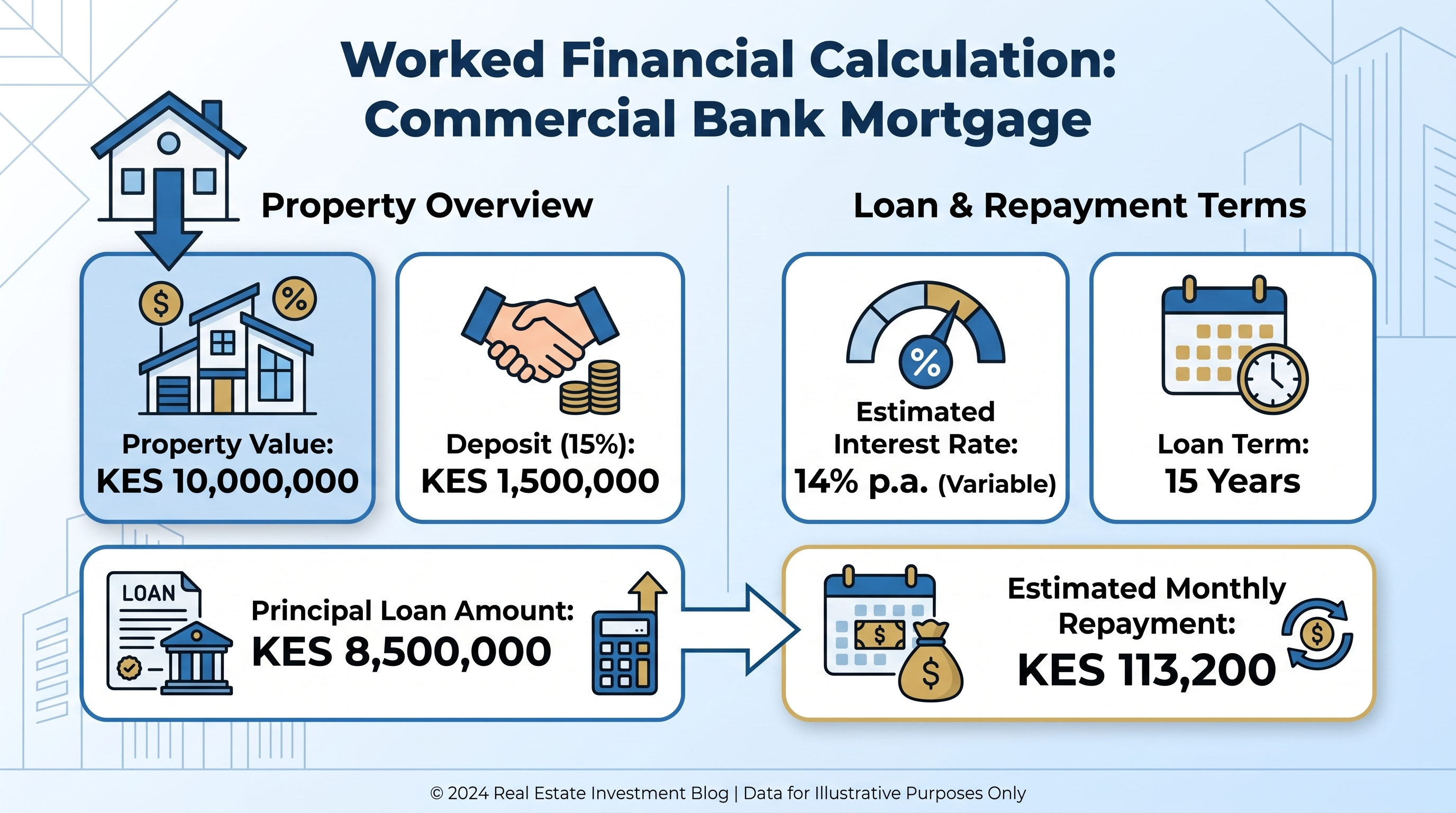
Worked Financial Calculation: Commercial Bank Mortgage
The SACCO Multiplier Effect
SACCOs operate on a fundamentally different model than commercial banks, prioritizing member savings and cooperative lending. According to Rehani Soko market intelligence, SACCOs are increasingly favored by investors who have the patience to build their capital over time. The core advantage of a SACCO is the fixed interest rate, which shields borrowers from the volatility of the broader financial market.
Estimated Financing Fee Breakdown in Nairobi
💰Processing & Negotiation
Commercial Bank Structure1.5% to 3% of total loan amount
SACCO Structure1% flat rate on loan amount
💰Interest Rate Model
Commercial Bank StructureVariable (CBK base rate + margin)
SACCO StructureFixed (Historically 12% to 14%)
💰Early Repayment Penalty
Commercial Bank Structure2% to 3% of outstanding balance
SACCO StructureZero penalties
💰Insurance Requirements
Commercial Bank StructureMandatory life and property cover
SACCO StructureOften bundled or highly subsidized
Transaction patterns confirm that diaspora buyers who consistently remit funds to a Kenyan SACCO benefit from the "multiplier effect." Most established SACCOs will lend you up to three or four times your accumulated savings. While you must wait and save, the reward is a highly predictable repayment schedule that makes long-term wealth generation much more manageable.
Area Comparison and Investment Yields
Securing the right financing is only half the equation; selecting the right neighborhood ensures your investment grows. Whether you intend to live in the home upon your return or rent it out for passive income, location dictates your success. Rehani Soko property analytics reveal distinct performance variations across Nairobi's key residential nodes.
By aligning your financing strategy with neighborhood performance, you can target exceptional returns. For instance, high-yield areas might justify the faster, slightly more expensive bank mortgage if the rental income can offset the monthly interest payments.
Next Steps for Your Journey Home
Taking the leap to invest in Kenyan real estate requires careful preparation, but you do not have to do it alone. Whether you lean toward the speed of a commercial bank or the stability of a SACCO, having the right tools at your disposal is critical.
Main LimitationRequires long-term savings accumulation and guarantors
Best Suited ForPatient buyers planning years ahead
✨
Commercial Bank
Faster approval timelines and higher loan limits
Main LimitationVariable interest rates tied to CBK fluctuations
Best Suited ForBuyers needing immediate funding for ready units
✨
Diaspora Mortgages
Tailored income verification for foreign earnings
Main LimitationOften requires higher initial deposits
Best Suited ForExpats securing high-value properties
You can start by evaluating your borrowing capacity and exploring current rates. If you are ready to take action, browse all properties to see what fits your budget. For specific financing calculations, use our mortgage calculator or directly get a mortgage quote. If you have specific legal or procedural questions, Ask Hani for immediate, AI-driven assistance.
Financial Calculation:
If you purchase a KES 9,000,000 property in Nairobi, a 20% bank deposit requires KES 1,800,000 upfront. Alternatively, to secure the same amount through a SACCO offering a 3x multiplier, you must have KES 3,000,000 in saved shares.
Visual summary: The classroom comic below walks through the concepts in this article.
📖
Hani Explains It
Page 1 of 2
5 Key Takeaways:
Market data consistently shows SACCOs provide stable, fixed interest rates.
High-Level Comparison of Financing Vehicles in Kenya
✨
Interest Rates
Variable (CBK guided)
SACCOsFixed (Internal policy)
✨
Speed of Access
60-90 days
SACCOs6+ months of prior saving
✨
Maximum Loan
Based on income/valuation
SACCOs3x to 4x of total savings
✨
Primary Benefit
Faster acquisition
SACCOsPredictable, lower long-term cost
Disclaimer: This article is for informational purposes only and does not constitute financial or legal advice. Real estate values and interest rates are subject to market changes.
When analyzing the current real estate market in Nairobi, many diaspora investors wonder if SACCOs or commercial banks offer a better route for financing. According to Rehani Soko market intelligence, the choice heavily depends on your investment timeline and available capital. Market data consistently shows that SACCOs are increasingly popular for those who can plan ahead, as they offer fixed interest rates that protect buyers from market fluctuations. Conversely, commercial banks provide faster access to capital for those who need to close a deal quickly, though they are subject to variable rates guided by the Central Bank of Kenya (CBK). For Kenyans living abroad, building a home in Nairobi represents a deep connection to their roots. Choosing the right financing vehicle ensures that this dream is built on a solid foundation, allowing you to secure exceptional returns over time while keeping strong ties to the homeland.