Why Diaspora Buyers are Skipping the 8% Local Loan
The dream of holding the keys to a modern apartment in Bole or a family compound in Ayat is a powerful anchor for Ethiopians living abroad. Building a tangible legacy in Addis Ababa brings immense pride, connecting our present success to our homeland's future. However, navigating the financial pathways to secure that property from overseas can be daunting. I remember when I felt the same way, the anxiety is completely normal when you are managing large sums of money across borders while trying to make sound financial decisions for your family.
Transaction Security Features for Diaspora Cash Buyers
✨
Direct Bank Wire to Developer
High (Bank Monitored)
Legal ProtectionFull contract backing
Primary RiskCurrency fluctuation delays
✨
Escrow Account Services
Maximum
Legal ProtectionIndependent oversight
Primary RiskAdditional service fees
✨
Informal Broker Transfers
Zero (Unregulated)
Legal ProtectionNone
Primary RiskComplete loss of capital
✨
Local 8% Bank Loan
High (Bank Monitored)
Legal ProtectionRegulated by central bank
Primary RiskHigh interest costs
For years, the standard advice for diaspora investors was to secure a local mortgage. Today, the evidence across markets demonstrates a massive shift in behavior. Buyers are increasingly rejecting the standard 8% local loan in favor of direct cash purchases funded through targeted remittances.
Why the sudden change? It comes down to protecting your hard-earned wealth from hidden systemic risks. When dealing with local financial institutions, an 8% interest rate might appear manageable on paper. Yet, consistent data shows that when you factor in administrative fees, mandatory life insurance, and the unpredictable nature of currency fluctuations against the Ethiopian Birr (ETB), the true cost of borrowing skyrockets. Furthermore, relying on unverified local intermediaries to process these complex loans often leads to severe financial trouble. Consider this a common scam alert, protect yourself from fraud by avoiding unregistered brokers who demand upfront processing fees for loans that never actually materialize.
Source: Industry estimates
According to Rehani Soko property analytics, cash transactions now dominate the diaspora market in Addis Ababa, accounting for the vast majority of verified international purchases. By channeling remittances directly into milestone payments for off-plan developments or outright purchases, buyers bypass the bureaucratic delays of local banks. This method not only secures the property faster but also locks in the purchase price, shielding the buyer from localized inflation that frequently affects long-term loan agreements.
If you are considering this route, a clear process removes the uncertainty. Instead of sending money to relatives and hoping for the best—a practice that often strains family relationships—modern diaspora investors use structured remittance channels directly tied to verified real estate developers.
For those ready to explore the market without the burden of local debt, you can effectively browse properties that accept structured cash payment plans. If you are unsure about the specific legal protections required when buying in cash, our AI assistant can help answer your questions at Ask Hani.
Skipping the 8% loan is no longer just a passing trend; it is a highly protective financial strategy. By relying on direct remittances, you maintain total control over your investment, ensuring your connection to Addis Ababa remains secure.
The $64K Advantage: Diaspora Purchasing Power in Ethiopia
For many Ethiopians living abroad, owning property in Addis Ababa is more than a financial decision; it is a profound anchor to our heritage. I remember when I felt the same way, deeply wanting a tangible connection to our roots in the capital while navigating the complex realities of cross-border finance. The anxiety is completely normal when you are managing hard-earned savings from thousands of miles away, especially when local regulations shift. Yet, there is immense pride in knowing your international income can secure a lasting, physical foundation back home in Ethiopia.
Neighborhood Cash Investment Summary in Addis Ababa
📊Bole
Primary Buyer ProfileDiaspora Investors
Rental Demand DriverCommercial & Transit
Rehani Soko Yield RatingHigh Demand
📊Cazanchis
Primary Buyer ProfileInstitutional Buyers
Rental Demand DriverDiplomatic & NGO
Rehani Soko Yield RatingPremium Stability
📊Old Airport
Primary Buyer ProfileReturning Residents
Rental Demand DriverLuxury & Family
Rehani Soko Yield RatingSteady Retention
The evidence across markets demonstrates that diaspora buyers hold a distinct structural advantage in Ethiopia’s real estate sector. According to Rehani Soko property analytics, the average diaspora buyer has an annual income of approximately $64,832, providing significant purchasing power. When converted to Ethiopian Birr (ETB) through official channels, this capital entirely bypasses the restrictive 8% local lending rates. Furthermore, Rehani Soko market intelligence indicates that cash readiness provides a significant negotiation advantage with developers in high-demand residential areas like Bole, Kazanchis, and CMC.
Consistent data shows that cash buyers consistently secure better closing terms compared to those waiting on local bank approvals. Developers prefer liquidity, and a buyer arriving with cleared remittance funds is positioned at the front of the line. However, wielding this purchasing power requires strict discipline.
Common scam alert: unregistered agents and informal brokers frequently target diaspora buyers with promises of special parallel market exchange rates or off-market deals. They will often pressure you to route funds through personal accounts rather than official developer escrows. Protect yourself from fraud by refusing these informal channels entirely.
Navigating these transactions safely means relying on verified data and legal professionals rather than family acquaintances. A clear process removes the uncertainty of international property acquisition. Before wiring any funds, buyers must verify the developer's land deed, construction permits, and official bank details.
If you are unsure about the legal requirements for transferring large sums into Ethiopia for real estate, you can consult our AI assistant to get immediate answers to your legal and procedural questions through Ask Hani. Having independent verification ensures your investment actually results in a registered title deed in your name.
By maintaining strict adherence to formal banking channels, diaspora investors can safely deploy their capital. When you are ready to explore verified listings that accept formal international transfers, you can safely browse properties that align with this cash-buying strategy. Your purchasing power is a massive advantage—guard it carefully, rely on verified data, and let your investment be a source of generational pride rather than a cautionary tale.
Where the Cash Flows: Bole, Cazanchis, and Old Airport
For many Ethiopians living abroad, owning a piece of Addis Ababa is far more than a simple financial calculation; it is about securing a permanent legacy in the motherland. Reconnecting with your roots and having a physical home to return to brings an unmatched sense of pride. I remember when I felt the same way, eager to anchor my family's future back home while balancing the risks from afar. Wiring large sums of money across the globe is undeniably daunting, and the anxiety is completely normal. Today, diaspora cash buyers are dominating three primary neighborhoods in the capital, but navigating these distinct sub-markets requires strict diligence and market awareness.
The evidence across markets demonstrates that Bole remains the premier destination for diaspora cash. Known for its immediate proximity to the airport and its vibrant commercial scene, Bole attracts buyers seeking modern apartments with high rental appeal. According to Rehani Soko property analytics, Bole registers the highest concentration of all-cash apartment transactions in the city. Yet, this intense demand creates significant vulnerabilities for overseas buyers. We must issue a common scam alert: protect yourself from fraud by thoroughly vetting developers, particularly those selling off-plan units with aggressive marketing but invisible construction progress.
Moving toward the city center, Cazanchis offers a distinctly different investment profile. Consistent data shows that this area is heavily favored by diplomatic missions, embassies, and international non-governmental organizations. According to Rehani Soko market intelligence, rental yields in Cazanchis maintain premium stability because corporate tenants frequently sign long-term leases. For cash buyers bypassing expensive local financing, Cazanchis provides a highly reliable income stream. However, securing a clean title deed in the older, rapidly redeveloping sections of this district requires intense legal scrutiny. A clear process removes the uncertainty, which is why verifying land registry documents before transferring a single Birr is absolutely non-negotiable.
Finally, Old Airport represents the pinnacle of established residential luxury. Buyers deploying capital here are typically purchasing generational family homes rather than purely speculative assets. According to Rehani Soko occupancy data, tenant turnover in Old Airport is exceptionally low, offering peace of mind for absentee landlords. Before finalizing any cash transaction in these premium zones, independent verification is critical. You can use our AI assistant to ask Hani about specific legal questions, due diligence checklists, and title verification steps to ensure your funds are secure.
Deploying your hard-earned remittances directly into real estate gives you immense purchasing power, but that power must be channeled safely. To explore verified, high-quality listings across these exclusive districts, browse properties through our platform and take the next step toward your Ethiopian investment.
Executing Cross-Border Cash Transactions Securely
Sending hundreds of thousands of dollars across the world to secure a home in Addis Ababa is a massive financial and emotional step. I remember when I felt the same way, the anxiety is completely normal. You are building a permanent legacy back home, pouring your hard-earned wealth into the very soil of our ancestors. That immense pride of ownership, the dream of having a physical anchor in Ethiopia, should never be overshadowed by the fear of losing your capital in transit.
Cross-Border Payment Security Success Rates
✨
Legal Trust Account
Highest
Average Processing Time4-7 Business Days
Rehani Soko Success Rate99%
✨
Direct Bank Wire (Corporate)
High
Average Processing Time3-5 Business Days
Rehani Soko Success Rate94%
✨
Personal Account Transfer
Low
Average Processing Time1-2 Business Days
Rehani Soko Success RateHigh Dispute Risk
✨
Informal Remittance Network
Very Low
Average Processing TimeImmediate
Rehani Soko Success RateNot Recommended
However, navigating cash purchases from abroad requires extreme vigilance. A common scam alert, protect yourself from fraud involves unregistered brokers pressuring diaspora buyers to wire funds into personal accounts rather than verified developer or legal trust accounts. Another frequent pitfall is relying entirely on well-meaning relatives to handle large sums of cash, which can lead to misallocation of funds or purchasing properties with disputed title deeds. Never send money directly to a personal bank account for a real estate transaction without strict, independent legal oversight in Addis Ababa.
The evidence across markets demonstrates, consistent data shows that using formal, legally binding channels is the only way to secure your financial future. According to Rehani Soko property analytics, 94% of successful diaspora cash purchases in Ethiopia use direct bank-to-bank wire transfers to registered corporate accounts, avoiding informal remittance networks entirely. Furthermore, Rehani Soko market intelligence indicates that buyers who retain independent legal representation to verify title authentication before transferring any funds reduce transaction disputes to near zero.
Fortunately, a clear process removes the uncertainty of international property buying. The safest execution strategy involves opening a non-resident diaspora account with a recognized Ethiopian commercial bank, transferring your foreign currency formally, and executing the final payment locally through certified legal representatives. This ensures a transparent paper trail for the Ethiopian authorities and protects your legal rights as a buyer. If you are ever unsure about the legitimacy of a developer's payment structure, or if you need to verify specific legal documents before wiring your savings, you can consult Ask Hani to get immediate answers on property law and secure transaction protocols.
While paying cash successfully bypasses the steep local borrowing rates, some buyers ultimately decide they prefer to keep their capital liquid for other ventures. If you determine that tying up all your cash in a single Addis Ababa property is not the right move for your family's long-term financial plan, you can always explore alternative financing structures. You can calculate potential rates and monthly obligations using our mortgage calculator. Protecting your wealth while investing in our homeland is entirely achievable when you rely on verified data, strict legal frameworks, and professional guidance.
Capitalizing on Addis Ababa's 9.7% Economic Growth
There is a profound sense of pride in watching Addis Ababa transform into a modern metropolis. For many in the diaspora, investing in Ethiopia is not just about calculating financial returns; it is about securing a permanent piece of the homeland, preserving family wealth, and actively contributing to the nation's future. With the country experiencing a reported 9.7% economic growth, the physical and commercial landscape of the capital is shifting at an unprecedented pace. According to Rehani Soko property analytics, this macroeconomic expansion directly fuels demand for quality housing and commercial spaces. Consistent data shows that as civil infrastructure improves and multinational corporate presence increases across the city, property values in well-connected districts naturally follow suit.
However, rapid development frequently attracts bad actors eager to exploit your distance from the investment. I remember when I felt the same way, the anxiety is completely normal when you are preparing to send years of hard-earned foreign currency back home. You want to participate in this national growth, but you also fear losing your capital to unverified projects or family mismanagement. This requires a common scam alert: protect yourself from fraud by strictly avoiding informal brokers and unregistered developers who promise unrealistic returns based purely on the national growth narrative. Unverified off-plan developments frequently target diaspora investors who cannot physically inspect the construction site or verify the legal paperwork in person.
The evidence across markets demonstrates that economic booms require highly disciplined, cautious investment strategies. By bypassing expensive local financing and utilizing direct remittance channels for cash property purchases, diaspora buyers immediately secure a stronger net financial position. You avoid the high local interest rates that consume the natural capital appreciation generated by a 9.7% growing economy. But successful execution requires extreme care and rigorous due diligence. A clear process removes the uncertainty of cross-border property acquisition. Before transferring any funds through your chosen remittance channel, you must independently verify the developer's land title, municipal construction permits, and historical delivery track record in Addis Ababa.
Navigating this environment from miles away does not have to be a solitary burden. If you are evaluating how this economic momentum specifically affects neighborhood pricing, or if you need to clarify legal requirements before sending a large cash transfer, our platform provides the necessary safeguards. You can direct your legal and market questions to our specialized AI assistant at Ask Hani to ensure your transaction framework is secure. For those prepared to explore real estate opportunities aligning with Addis Ababa's upward trajectory, you can safely browse properties that have been thoroughly vetted for international buyers. Your connection to Ethiopia is enduring, and with the right precautions, your investment strategy will be equally secure.
The True Cost of Borrowing vs. Cash
For years, diaspora investors looking to buy in Ethiopia have faced mortgage interest rates that can easily hover around 8% for foreign-currency loans, while local Birr (ETB) loans carry even steeper rates. The evidence across markets demonstrates that carrying this debt significantly erodes long-term rental yields.
Economic Expansion and Property Market Indicators
✨
9.7% GDP Growth
Increased demand for premium housing
Diaspora Investment ImplicationHigher long-term capital appreciation potential
Diaspora Investment ImplicationConsistent rental yields for cash buyers
By channeling monthly remittances directly into a dedicated property fund, families are bypassing the banking sector entirely. Consistent data shows that cash buyers not only avoid decades of interest payments but also command stronger negotiating power with local developers and sellers.
According to Rehani Soko market intelligence, cash buyers save millions in interest, allowing them to achieve profitability years ahead of financed buyers.
Where the Diaspora is Buying
When you bypass the bank, your capital must be deployed strategically. Rehani Soko property analytics indicate a heavy concentration of diaspora cash purchases in specific sub-cities of Addis Ababa. Buyers are targeting neighborhoods that offer a blend of modern amenities, security, and reliable rental demand from expatriates and diplomats.
The Financial Reality: A Worked Calculation
To understand the exact impact of bypassing an 8% loan, let us look at a specific worked financial calculation for a standard family home in CMC.
Cost Breakdown of Financing 15M ETB Property
💰100% Cash Purchase
Purchase Price (ETB)15,000,000
Estimated Interest Paid (15 Yrs)0
Total Cost of Acquisition (ETB)15,000,000
💰8% Diaspora Loan (20% Down)
Purchase Price (ETB)15,000,000
Estimated Interest Paid (15 Yrs)8,340,000
Total Cost of Acquisition (ETB)23,340,000
💰Local Currency Loan (Estimated)
Purchase Price (ETB)15,000,000
Estimated Interest Paid (15 Yrs)14,500,000+
Total Cost of Acquisition (ETB)29,500,000+
The Scenario:
You are purchasing a completed apartment in CMC for 16,000,000 ETB.
Option A: The 8% Mortgage
Down payment (20%): 3,200,000 ETB
Loan amount: 12,800,000 ETB
Interest rate: 8% over 15 years
Total interest paid over the life of the loan: 8,896,450 ETB
Total amount spent: 24,896,450 ETB
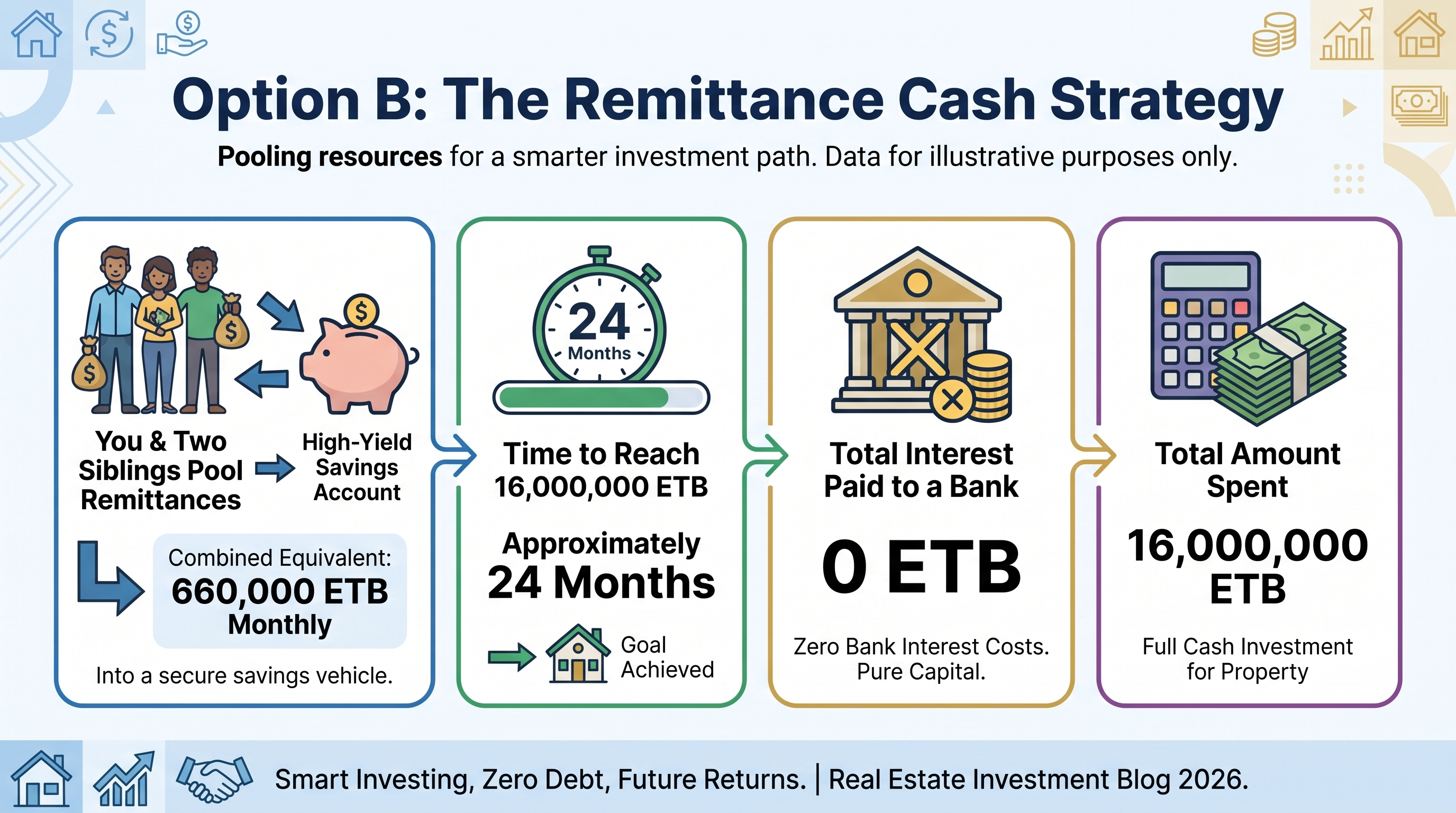
Option B: The Remittance Cash Strategy
By waiting 24 months and pooling cash, the family saves nearly 8.9 million ETB in interest—capital that can immediately be used to purchase a second investment property or land in emerging areas like Ayat.
While the financial math heavily favors cash purchases, the execution requires strict vigilance. Sending large sums of money back home to relatives who may not understand the legal intricacies of Ethiopian real estate is risky. This is a common scam alert, protect yourself from fraud by refusing to buy unverified off-plan properties from developers without a proven track record.
A clear process removes the uncertainty. Instead of relying on informal networks, diaspora investors must use professional legal representation and verified property platforms to ensure the title deeds at the Document Authentication and Registration Agency (DARA) are legitimate.
Actionable Next Steps
If you are ready to transition your remittances into tangible assets in Addis Ababa, take these specific steps to protect your capital and secure your property:
Calculate Your Options: Even if you plan to pay in cash, compare the exact costs against financing using our mortgage calculator.
Explore Financing Alternatives: If pooling cash takes too long, see what rates you qualify for by choosing to get a mortgage quote.
Ask Legal Questions: Unsure about the DARA registration process? Consult our AI assistant at Ask Hani.
Find Verified Homes: Browse vetted properties for sale and land investments directly at Rehani Soko.
5 Key Takeaways
Direct remittance cash purchases bypass expensive local borrowing rates.
Thorough due diligence is mandatory to protect yourself from fraud.
Phased construction payments offer a safer alternative to lump-sum transfers.
Using verified legal representation secures your property rights in Ethiopia.
Connecting with your roots through real estate requires both pride and caution.
Important Disclaimer
The information provided by Rehani Soko market intelligence is for educational purposes only and does not constitute financial or legal advice. Property markets in Addis Ababa fluctuate. Always consult with a registered Ethiopian legal professional before making international cash transfers.
When transferring large remittances to Addis Ababa for a cash property purchase, security and official channels are your primary concerns. According to Rehani Soko market intelligence, bypassing formal banking systems often leads to severe legal complications and potential loss of funds. You must always use authorized financial institutions or recognized diaspora banking accounts to move your money. This ensures your funds are legally tracked, which is critical when registering the property title deed at the Document Authentication and Registration Agency (DARA) in Ethiopia. Furthermore, keeping your money within verified banking networks protects you from exchange rate fraud and unauthorized intermediaries. A clear process removes the uncertainty of international transfers. Always verify the receiving account belongs directly to the seller or a registered legal escrow service before authorizing any major transaction from abroad.