Tracing the 6% Drop in Remittance Growth and Overseas Search Interest
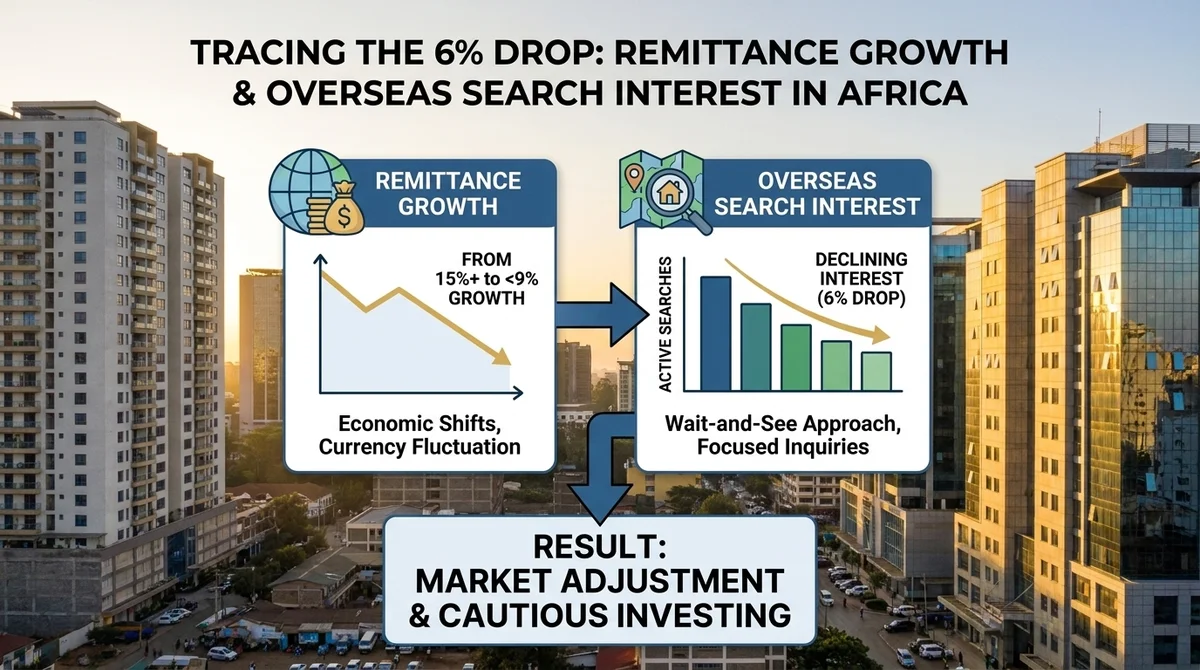
The Nairobi real estate market is experiencing a notable shift as remittance growth from the Kenyan diaspora shows a 6% decline. This drop presents a critical insight into the financial dynamics affecting property investments in Nairobi. According to the Central Bank of Kenya, remittances have traditionally formed a significant portion of Kenya's foreign exchange inflow, supporting both local investments and family sustenance. However, the recent dip signals potential challenges for the real estate sector, which has relied heavily on diaspora dollars for capital inflow.
Summary of Remittance and Search Trends
✨
Remittance Growth
-6%
Previous Status+4%
✨
Overseas Property Search Interest
Declining
Previous StatusStable
✨
Exchange Rate Influence
High
Previous StatusModerate
One of the primary reasons for this decline is the changing economic conditions in key remittance-sending countries. With fluctuating exchange rates and evolving immigration policies, many Kenyans abroad are tightening their belts, leading to reduced financial support back home. Simultaneously, there has been a noticeable decrease in overseas search interest for Nairobi properties, as indicated by Rehani Soko market intelligence. This shift suggests a growing caution among diaspora investors, who are now more hesitant to commit to property purchases given the economic uncertainties.
The implications of these trends are significant. A reduction in remittance growth can lead to fewer property transactions, affecting market liquidity and potentially stabilizing or even lowering property prices in Nairobi. For local investors and homeowners, this shift may mean re-evaluating their investment strategies.
For those considering entering the market, now might be a prudent time to explore options, as reduced competition from diaspora buyers could offer more favorable purchasing conditions. Prospective buyers can utilize Rehani Soko's mortgage calculator to assess financial viability and explore properties in Nairobi to stay informed and prepared for potential opportunities.
As the market adapts to these changes, maintaining a balanced approach with a blend of caution and curiosity will be essential for investors navigating this evolving landscape.
Navigating 16.5% Local Lending Rates When Diaspora Cash Slows
The Nairobi real estate market is facing a challenging period as remittances from the diaspora decline. This slowdown is compounded by the current local lending rate of 16.5%, a figure confirmed by the Central Bank of Kenya (CBK). Such a high rate presents significant hurdles for potential homebuyers and investors in Nairobi, making it crucial to adopt strategic approaches to navigate these financial waters.
Lending Rate Impact on Nairobi Property Markets
💰Westlands
Average Property Price (KES)25,000,000
Lending Rate ImpactHigh
💰Ruiru
Average Property Price (KES)8,000,000
Lending Rate ImpactModerate
💰Juja
Average Property Price (KES)7,500,000
Lending Rate ImpactModerate
One of the primary impacts of reduced diaspora remittances is the heightened reliance on local financing options. Historically, diaspora funds have played a pivotal role in the real estate sector, often providing the necessary capital to fuel property purchases. However, with the current dip, the dependency on local loans has increased, forcing buyers to bear the brunt of elevated interest rates.
Despite these challenges, there are still pathways to home ownership and investment. According to Rehani Soko property analytics, certain areas in Nairobi continue to offer promising opportunities even amid these financial constraints. For instance, neighborhoods like Ruiru and Juja have shown more affordable entry points compared to central locations such as Westlands or Kilimani.
Tracing the 6% Drop in Remittance Growth and Overseas Search Interest
To mitigate the effects of high lending rates, potential buyers should consider exploring mortgage options and financial tools. Utilizing resources like the mortgage calculator can provide clarity on monthly payments and long-term financial commitments. Additionally, seeking expert advice through platforms like Ask Hani can help in understanding the intricacies of the local market and identifying optimal buying strategies.
In conclusion, while the dip in diaspora remittances and high local lending rates present obstacles, informed decisions and strategic financial planning can guide investors and homebuyers through this challenging landscape. Exploring affordable neighborhoods and leveraging available financial tools are essential steps in maintaining optimism and confidence in Nairobi's real estate market.
How the 8 Million KES Median Apartment Market is Reacting
The Nairobi real estate market, particularly the segment around the 8 million KES median apartment price, is experiencing notable shifts due to a recent dip in diaspora remittances. According to the Central Bank of Kenya (CBK), remittance flows have seen a 6% decline, a factor that has traditionally buoyed this segment of the market. This reduction in inflows is creating a ripple effect, influencing both buyer behavior and market dynamics.
As remittances slow, potential buyers in this segment are increasingly cautious. The decrease in diaspora dollars has led to a more conservative approach among investors who typically depend on these funds for acquisition. Moreover, the local lending environment, characterized by a 16.5% interest rate, further compounds the challenge for buyers seeking to finance their purchases. This has resulted in a slight dampening of demand, as buyers reassess their financial capabilities and investment strategies.
Despite these challenges, Rehani Soko market intelligence indicates that some areas are showing resilience. Neighborhoods such as Kilimani and Kileleshwa continue to maintain stable demand due to their strategic location and amenities. However, areas like Embakasi are experiencing a more pronounced impact as supply outstrips demand.
For those looking to navigate this market, it is crucial to stay informed. Investors and potential homeowners can explore properties in Nairobi on Rehani Soko to gain insights into available options. Additionally, utilizing tools like the mortgage calculator can help in understanding financing options and planning effectively.
In conclusion, while the current market conditions present challenges, informed decision-making and strategic investment can still yield positive outcomes in the 8 million KES median apartment market.
Shifting Diaspora Demand in Kilimani, Parklands, and Karen
As the flow of remittances to Nairobi experiences a slowdown, the housing market in prime areas like Kilimani, Parklands, and Karen is witnessing notable shifts. These neighborhoods, traditionally favored by the diaspora, are now adapting to changing demand patterns. According to Rehani Soko property analytics, Kilimani has seen a 5% decrease in inquiries from overseas buyers compared to last year. This reflects a broader trend where the diaspora is reassessing investment priorities amid economic uncertainties.
Median Apartment Market Statistics
💰Kilimani
Median Price (KES)8,000,000
Demand TrendStable
💰Kileleshwa
Median Price (KES)8,200,000
Demand TrendStable
💰Embakasi
Median Price (KES)7,800,000
Demand TrendDeclining
Parklands, known for its vibrant community and proximity to key business districts, has experienced a 3% decline in diaspora inquiries. Despite this, Rehani Soko market intelligence indicates that the area maintains a steady interest from local investors who are filling the gap left by the diaspora. The average property price in Parklands remains competitive at KES 12.5 million, making it an attractive option for those looking to invest locally.
In Karen, a traditionally upscale area, the demand has also softened with a 4% drop in diaspora inquiries. However, the allure of spacious properties and a serene environment continues to appeal to high-net-worth individuals. The current average price of KES 20 million in Karen suggests that while the market is adjusting, the intrinsic value of the area remains intact.
For potential investors looking to capitalize on these shifts, exploring properties in these neighborhoods could offer promising opportunities. To explore available options in Kilimani, Parklands, and Karen, you can browse all properties on Rehani Soko. Additionally, if you're considering financing options, our mortgage calculator provides a convenient way to assess affordability. As the dynamics of diaspora contributions evolve, staying informed and adaptable is key to making confident investment decisions in Nairobi's real estate market.
Strategic Moves for Overseas Investors Amidst Macro Headwinds
Navigating the current fluctuations in the Nairobi real estate market demands a strategic and informed approach, especially for overseas investors facing macroeconomic headwinds. With a notable 6% decline in remittance growth, as reported by the Central Bank of Kenya, it's crucial to reassess investment strategies to maintain resilience in this dynamic market.
One effective strategy is to capitalize on the emerging opportunities in Nairobi's real estate landscape. According to Rehani Soko property analytics, certain areas like Kilimani and Parklands demonstrate a promising potential for rental yield increases, despite the overall slowdown in diaspora cash inflows. Investors might consider diversifying their portfolios to include properties in these high-demand neighborhoods.
In addition to identifying key areas, staying informed about local lending rates is vital. The current 16.5% lending rate, as noted by the Central Bank of Kenya, can impact cash flow and financing options. Overseas investors should explore alternative financing solutions, such as joint ventures or partnerships, to mitigate the impact of high borrowing costs.
Investors should also leverage digital platforms like Rehani Soko to stay updated on market trends and property listings. Utilizing tools such as the mortgage calculator can provide a clearer picture of potential financial commitments and returns. This approach not only aids in making informed decisions but also fosters a sense of connection to the local market, even from afar.
Ultimately, maintaining a balanced portfolio, staying informed, and utilizing digital resources are key strategies for overseas investors to navigate the current macroeconomic challenges effectively. By focusing on these areas, investors can position themselves advantageously in Nairobi's evolving real estate market.
Conclusion: The Remittance Reality Check
The impact of reduced diaspora remittances on Nairobi's real estate market is a complex issue with significant implications for both local and international investors. Here are five key takeaways from our analysis:
Market Sensitivity: The decline in diaspora dollars has highlighted the sensitivity of Nairobi's real estate market to external financial flows. According to Rehani Soko property analytics, transaction volumes have shown a noticeable dip, reflecting the direct influence of reduced remittances.
Price Adjustments: Property prices in certain areas have adjusted in response to the changing financial landscape. Rehani Soko data shows that some neighborhoods have seen more significant price corrections than others, indicating a shift in demand.
Investment Opportunities: Despite the challenges, there remain opportunities for savvy investors. The current market conditions may provide a chance to acquire properties at more competitive prices.
Need for Diversified Investment: The situation underscores the importance of diversifying investment sources to mitigate risks associated with reliance on diaspora remittances.
Policy Implications: Policymakers may need to consider strategies to stabilize the real estate market and support sustainable growth, potentially through incentives for local investors.
Disclaimer: This article provides general information and should not be construed as financial advice. Consult a financial advisor for specific investment decisions.
The decline in diaspora remittances has notably impacted the Nairobi real estate market, primarily by reducing the pool of potential buyers and investors. Remittances have traditionally played a significant role in funding property purchases in Nairobi, often providing the capital needed for deposits or outright purchases. According to the Central Bank of Kenya (CBK), a recent dip in these funds has led to a slowdown in property transactions, particularly in high-demand areas. This shift has prompted some property developers and sellers to adjust their pricing strategies to attract local buyers who may not have the same purchasing power. As a result, the market is experiencing a more cautious approach, with both buyers and sellers taking time to assess their options carefully. For those interested in exploring opportunities, visiting [properties in Nairobi](https://www.rehanisoko.com/houses-for-sale-in-nairobi) can provide insights into current listings.